
Managed Wi-Fi in apartments is a single, property-wide network operated as a service: connect or plug-and-play for residents, proactive for operators, and designed to perform when the building is busiest. While this might sound simple, it is an incredibly complex problem. Wi-Fi shares one medium, and multifamily packs hundreds of radios and thousands of devices into concrete boxes. Conditions change constantly and static channel plans fall apart. Plume Uprise solves this with Harmony, an adaptive control layer that forms RF-based clusters, matches device demand to available airtime, and steers clients in real time. This dynamic approach results in fewer slowdowns at peak, fewer support tickets, and a better resident experience. Below we will unpack our understanding of how Plume Uprise works and how it is different from legacy “managed Wi-Fi”.
Step 1: Form clusters based on actual RF reality (not floor plans)
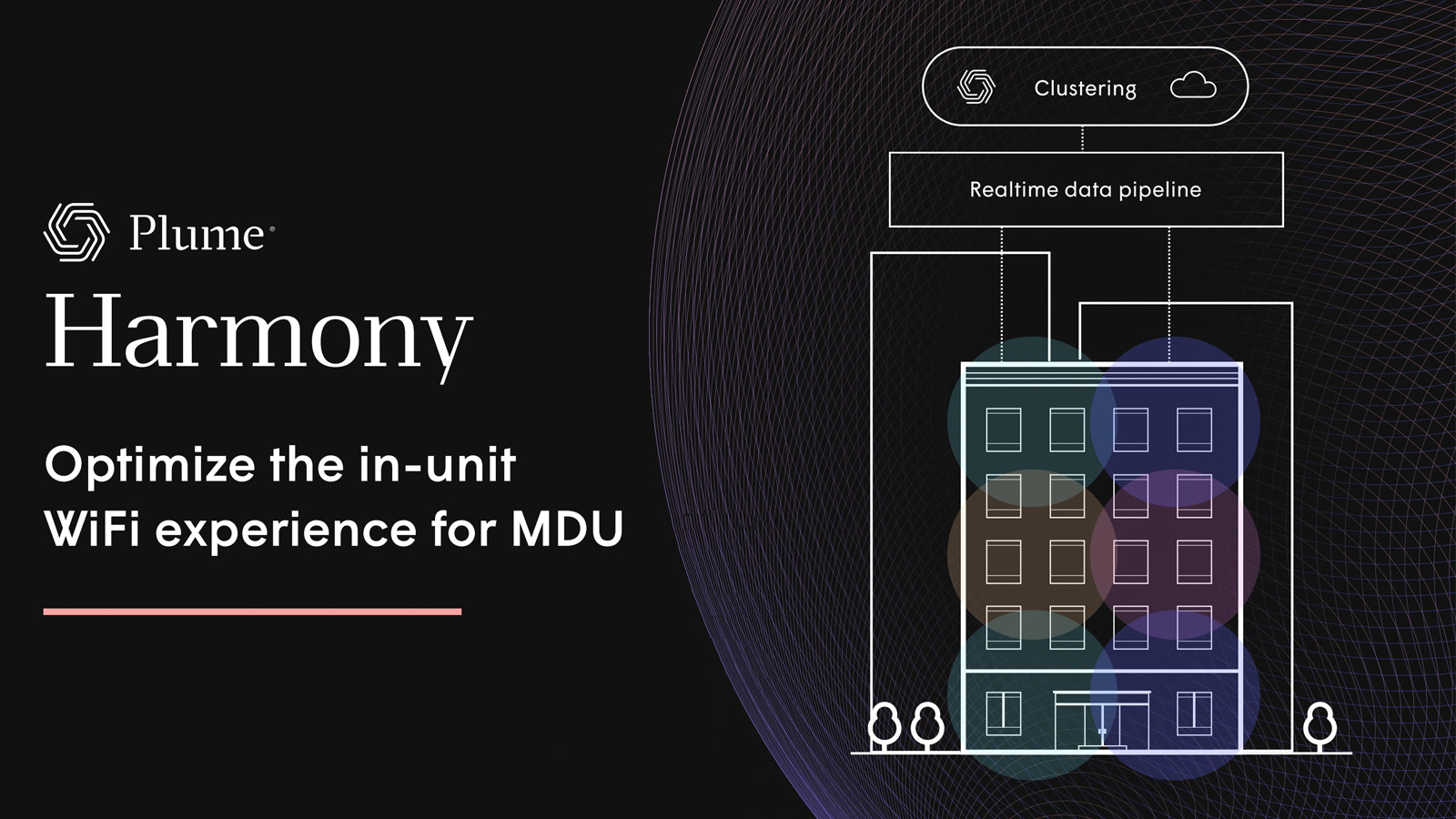
Harmony begins by auto-grouping locations and access points into “clusters” using radio-frequency proximity. Instead of treating every unit as an island, it models which APs actually hear each other and at what signal strengths. That RF-neighbor map becomes the basis for coordinated decisions so adjacent APs don’t fight over the same airtime. In Plume’s words, it’s “an algorithm that auto-groups locations and APs based on their RF proximity to optimize bandwidth across the entire MDU.”
Legacy deployments often assign channels per floor, per unit, or by simple reuse patterns. But signal bleeds in three dimensions, and resident-added devices (TVs, microwaves, baby monitors, IoT) change contention patterns constantly. Cluster formation grounded in measured RF lets optimization happen where interference is real, not where a CAD drawing says it might be. Plume Uprise reinforces this whole-building view with “MDU Interference Management,” a learning algorithm that optimizes clusters based on peak usage time and need.
Step 2: Match “airtime demand” to “airtime supply” per AP
Once clusters are in place, Harmony applies an airtime optimization algorithm. Conceptually, it computes two curves for each AP:
- Airtime demand: how much transmission time clients in the AP’s cell want. This is a function of traffic load, PHY rates, MCS/guard intervals, retries, and per-flow behavior (e.g., video vs. voice vs. best-effort).
- Airtime supply: how much clean, usable airtime the AP has, bounded by channel width, interference in the cluster, duty-cycle/busy time, and regulatory constraints.
Harmony’s scheduler then matches demand to supply by choosing channels and distributing load so that each AP runs at a healthy utilization level with minimal overlap. Importantly, channel selection and device steering are made with cluster-level context (not just per-AP statistics), so you avoid the “whack-a-mole” effect where fixing one AP worsens a neighbor. Plume documents this as “a channel selection algorithm [that] matches airtime demand to airtime supply per AP, automatically steering tenant devices to the optimal channel based on cluster density and spectrum availability.”
Step 3: Quantify pain and optimize at the right times
Harmony’s “pain metric” is a simple way to decide where and when it should tune the network. For each AP, it compares airtime demand (how much transmission time users and apps are asking for) against airtime supply (how much clean, interference-free airtime is actually available). That core ratio is informed by practical signals operators care about: channel busy time, retry/error rates, neighbor density (how many nearby APs are shouting on the same channel), and queue delay at the radio. Harmony watches how this metric moves across the day and week to learn each property’s peak windows (e.g., 7–10 p.m.), then concentrates changes where they’ll help the most: cluster-level channel/power tweaks when interference is the driver, or client/band steering when a few APs are simply overworked.
To keep things steady, Harmony adds guardrails: minimum “dwell” times between changes, small test rollouts before applying a plan broadly, and automatic rollback if the pain metric, or user KPIs like latency and jitter get worse. The net effect is practical and visible: less churn in quiet cells, proactive tuning before the evening surge, and measurable relief where congestion is real, not theoretical.
Step 4: Use the control plane to actually move clients and rebalance load
Picking a great channel plan only gets you halfway there; you still need to move devices onto better radios and bands. Uprise relies on the OpenSync® control plane to do this at scale. OpenSync® provides the telemetry and control hooks for band steering and client steering, cloud-coordinated configuration changes, and continuous stats streaming back to Plume Cloud. In practice, that gives Harmony the levers to shift sticky clients, bias dual or tri-band devices to the right band, and keep per-radio utilization balanced without on-site intervention.
- Band steering nudges dual or tri-band clients toward higher-capacity spectrum when feasible (e.g., 5 GHz / 6 GHz), reducing collisions and improving aggregate throughput.
- Client steering uses live signal/quality and AP-load inputs to hand a device to a better neighbor, avoiding overloaded cells and “sticky” associations.
- Because the steering logic sits in a cloud-managed middle layer (OpenSync®), changes can be orchestrated cluster-wide and rolled back if conditions degrade. Some legacy managed Wi-Fi controllers struggle to do this gracefully.
Step 5: Integrate traffic awareness to protect time-sensitive apps
As those peak windows emerge, Harmony doesn’t just reshuffle channels; it also signals when RF headroom is limited and traffic needs smarter handling. That’s where Full Stack Optimization comes in. RF is only half the story; prime-time quality hinges on which packets win airtime. Plume classifies live flows (voice, streaming, conferencing, gaming, security) and maps them to Wi-Fi Multimedia access categories so latency-sensitive frames contend less and transmit sooner, while preserving DSCP markings through the wired path. Paired with Harmony’s cluster-level decisions, this ensures residents are on the best AP/channel and that the right traffic stays smooth when airtime is scarce, translating directly into fewer “Paramount+ is glitchy at ~8 PM” tickets even under heavy load.
Plume Uprise Powers The Next Generation of Managed Wi-Fi
RF-aware clustering vs. static patterns. Cluster decisions are based on measured proximity and contention, not floor labels or a one-time site survey. That yields channel plans and power decisions that remain valid as residents churn and device mixes change.
Airtime math, not signal-bars. Harmony optimizes airtime, the true scarce resource in Wi-Fi. Many systems “optimize” RSSI or throughput per client in isolation; Harmony balances shared medium time across the cluster, which is what prevents retries, bufferbloat, and stalls under load.
Closed-loop steering with a programmable control plane. OpenSync’s cloud-backed telemetry and steering let Uprise enforce its plan, pushing clients, adjusting channels, and validating the effect. Legacy setups often leave clients where they first associated and hope RRM catches up.
Optimized when it matters most. The pain-metric approach focuses tuning around peak usage, preventing the classic “it worked at noon, failed at prime time” complaint profile.
Application-aware prioritization. By pairing RF optimization with application-level QoS, Uprise preserves experience when everyone hits the network at once, critical for renewal-driving amenities like 4K streaming, gaming, and work-from-home calls.
The Internet Subway Difference
For Internet Subway, the most important metric is silence: fewer tickets, fewer truck rolls, and residents who don’t think about Wi-Fi because it just works. Uprise is explicitly built for that outcome in MDUs: MDU interference management, RF-proximity clustering, airtime-driven channel selection, cloud-coordinated steering, and application-aware traffic shaping, all tuned to a multifamily building’s real usage patterns. Internet Subway builds on the power of Plume Uprise with PMS integration and resident onboarding automation, making the process seamless for both residents and property teams. Underpinned by a future ready multigigabit infrastructure and top tier experience support, the Next Generation of Managed Wi-Fi is here.