
Residents do not care how difficult a building is to wire. They care that the internet works when they move in, keeps working after they are settled, and does not become another thing they have to chase the leasing office about.
Property owners care about the resident experience too, but they also care about the operating model behind it. A good network should reduce onsite friction, support the leasing and maintenance teams, create room for future property technology, and hold up over time. That is where a lot of bulk internet and managed Wi-Fi conversations end up being too shallow. It is easy to reduce the whole thing to unit count, price per door, and how many access points go in the building. That may be enough to quote a job, but it is not enough to design the right network.
Every multifamily property has its own physical reality. A 15-building garden-style community spread across 10+ acres is a different project than a 410-unit single building high-rise. A 1970s mid-rise with limited pathways, legacy coax, and no clean telecom riser is different from new construction that was planned with fiber and low-voltage pathways in mind. Building type, construction material, unit layout, risers, closets, existing conduit, available pathways, site topology, and access limitations all affect the final design.
At Internet Subway, we use a consistent toolkit, but we do not force the same design onto every property. The property tells us what the network needs to be.
The Toolkit
Most of our deployments are built around XGS-PON, which uses passive fiber distribution and optical splitters instead of powered electronics throughout the property. This can make a difference at multifamily communities because closets are usually tight, power is not always available where you want it, and cooling is rarely designed for extra telecom equipment. Passive fiber reduces the number of powered devices in the field, limits points of failure, and gives the property a cleaner long-term operating model.
XGS-PON also gives us ~10 gigabit symmetrical capacity, which supports multigigabit resident tiers today and leaves room for future demand. From the splitter, we run fiber to the unit, where an ONT terminates the optical signal and connects to the in-unit gateway and Wi-Fi 7 access point.
That is the basic toolkit. The actual design starts when we apply it to the property in front of us.
Garden-Style Communities
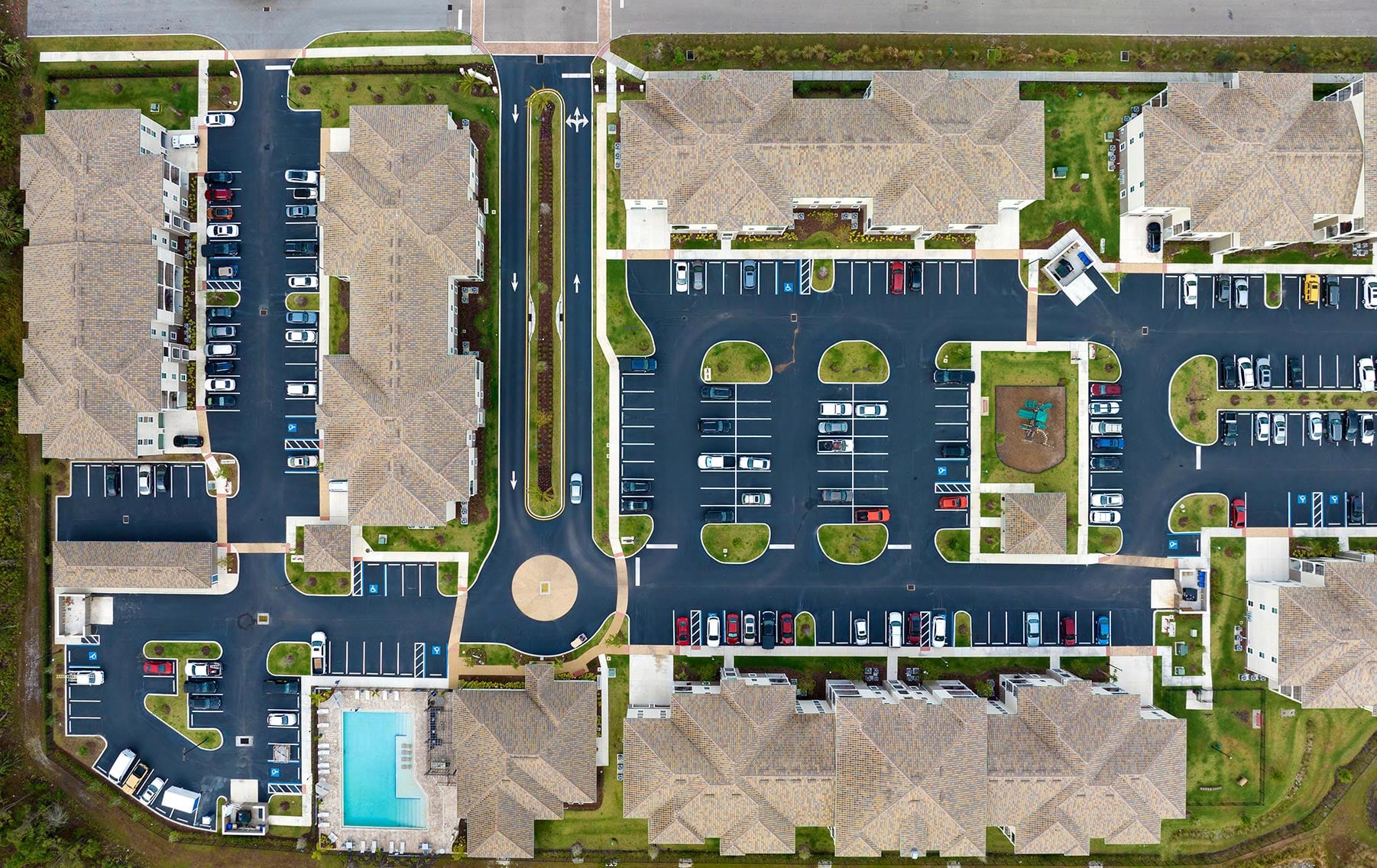
Garden-style communities are usually outside plant projects as much as they are building projects. The network has to move across a campus, between buildings, through landscaped areas, under parking lots, around existing utilities, and sometimes across long distances. The hard part is not just getting fiber to the property. It is building a distribution plan that can serve every building cleanly and still be maintainable later.
For these communities, we are typically thinking about underground conduit, handholes, backbone fiber, building entry points, and the right split architecture for the site. Sometimes a central headend feeding each building is the cleanest approach. Sometimes a cascaded design with intermediate split locations closer to building clusters makes more sense. The site plan, existing conditions, construction impact, and future serviceability all influence the answer.
This is why a garden-style property cannot be designed from a unit count alone. Two communities with the same number of units can have completely different network designs depending on building spacing, asphalt, landscaping, available pathways, and where the fiber can actually travel.
Mid-Rise Buildings
Mid-rise buildings usually come down to vertical pathway. If the building has usable telecom risers, the design can be fairly straightforward: bring backbone fiber up the riser, place distribution at each floor, and run laterally to the units. When the risers are clean, accessible, and properly located, the building gives you a logical network path.
When the risers are full, blocked, missing, or unusable, the work changes quickly. Then we have to evaluate other options, including mechanical spaces, exterior routes, core drilling, existing low-voltage paths, or other ways to move fiber through the building without creating a messy installation or a support issue later. Wood-frame buildings usually give more flexibility. Concrete and steel buildings require more planning and a tighter installation method.
Our goal is not to force a standard template onto the building, rather to understand the building well enough to create the cleanest, most serviceable path to every unit.
High-Rise Towers
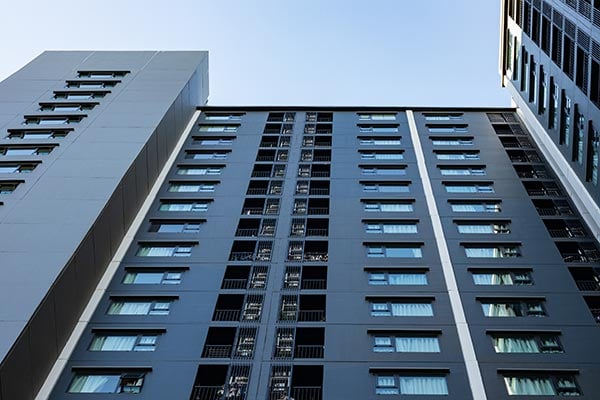 High-rise buildings can look simple because it is one address, one building, and likely stacked data closets. In the field, they are usually more complicated. Risers may be crowded, closet space may be limited, floor plans may be odd, and unit density may be high. Concrete, steel, elevator cores, and mechanical rooms can all affect both the fiber pathway and the wireless design.
For high-rise work, we have to be more deliberate about where equipment is placed, how fiber moves vertically, how each floor is served, and how the in-unit Wi-Fi will actually perform. The RF design is critical because the building materials can change the resident experience in a real way. A layout that works in a wood-frame building may not work the same way in a concrete tower.
We are not trying to win on a clever diagram. We are trying to build a network that can actually be installed, supported, and lived with inside the building.
A 360 Degree Site Survey
For retrofit communities, we tour and document your property. A property assessment is not just a walkthrough or a box to check before installation. It is where the network design starts. We are looking at where fiber enters the property, how backbone fiber can move, what risers and closets are usable, where splitters should live, what pathways are available, how each unit can be reached, and what building conditions could create installation or support issues later.
Those details determine the network. They decide where the headend belongs, how fiber moves across the property or through the building, where distribution points should be placed, how each building or floor is served, and how we get fiber into each unit.
A garden-style community may need a campus fiber plan with conduit, handholes, and distributed split locations. A mid-rise may depend on risers, floor-level distribution, and clean lateral pathways. A concrete tower may require compact enclosures, tighter pathway planning, and more detailed RF modeling.
Same toolkit. Different design. That is the point. Multifamily internet is not just a commodity service dropped onto a property. Done correctly, it is infrastructure built around the asset itself. Every multifamily property is a unicorn. Its network should be designed that way. Want to know what this would look like at your property? Let’s take a look.