
Apartment buildings are one of the hardest places to deliver great Wi-Fi. Not because Wi-Fi is bad technology, but because apartment communities put hundreds of residents, thousands of devices, and dozens of overlapping networks inside the same walls. Everyone is trying to use the same limited wireless airspace, and in multifamily that airspace gets crowded quickly.
This is where residents feel the pain. A resident is on a Zoom call at 4:30 PM, the connection freezes, and they assume the internet is slow. Maybe they move closer to the router. Maybe they restart the modem. Maybe they call the leasing office. But in a dense apartment building, the issue is often not the speed package or the fiber coming into the property. It is the wireless environment inside the building.
Density is a Big Problem
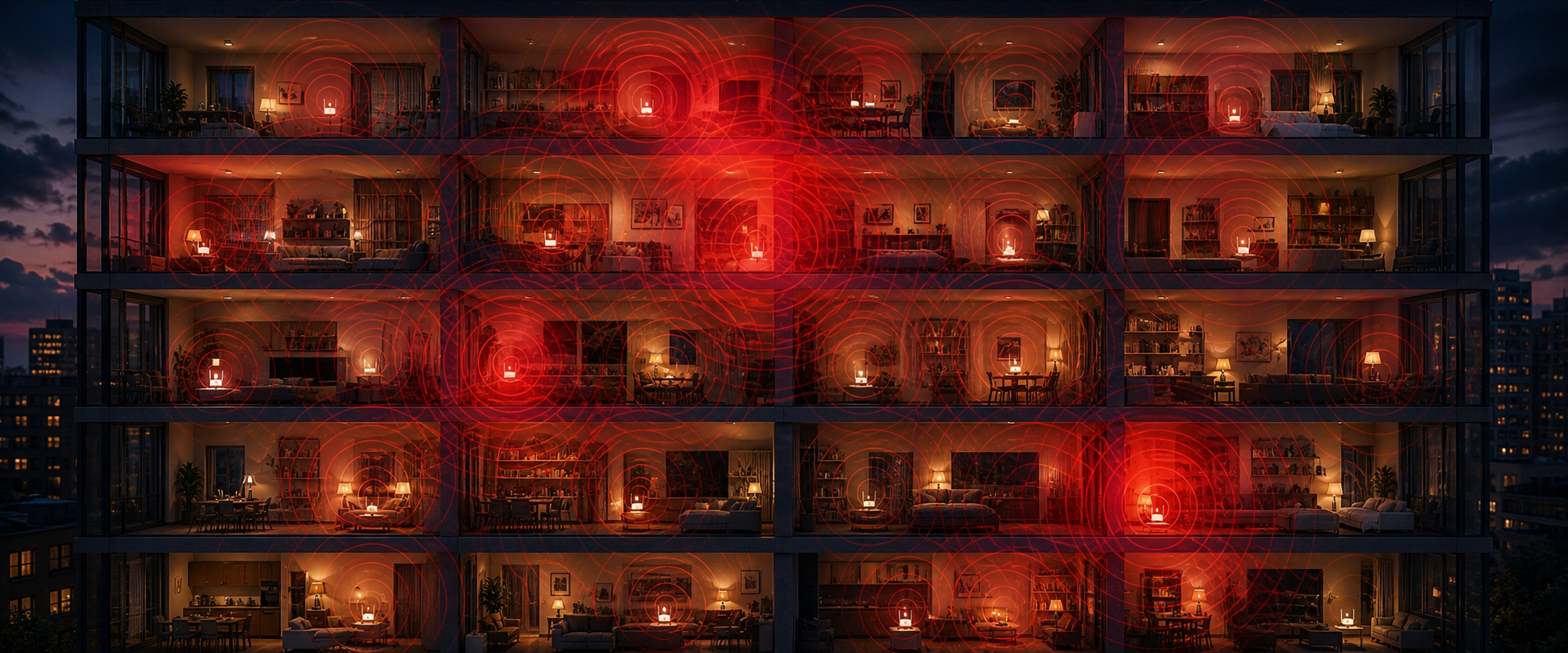
In a traditional apartment internet setup, every resident brings their own router. Every router chooses a channel, sets its own power level, and pushes signal through walls, ceilings, floors, hallways, and neighboring units. None of those routers know what the rest of the building is doing. They are all making local decisions in a shared environment.
A technical paper prepared for the SCTE Technical Journal studied this problem in dense neighborhoods, including apartment buildings and condos. The authors described what happens when each home has its own Wi-Fi access point and only a small number of non-overlapping channels are available: neighboring homes end up sharing channels, competing for airtime, and creating the conditions for slower speeds, higher latency, and buffering.
That is a good summary of the multifamily Wi-Fi problem: too many radios, too little clean spectrum, and no coordination.
The 2.4GHz Band is Ugly
The 2.4GHz band was never built for modern apartment density. It travels far, goes through walls well, and supports older devices, smart home gear, printers, cameras, thermostats, and a long list of inexpensive connected devices. That can be useful in the right environment, but in an apartment building it creates a mess.
2.4GHz Wi-Fi has only three clean non-overlapping channels commonly used in the U.S.: 1, 6, and 11. In a single-family home, that can work fine. In a 300-unit apartment community, those three channels get crowded very quickly. Every resident router spills signal into neighboring units. Every smart device adds more noise. Every unmanaged network makes its own decisions. The result is a small slice of spectrum carrying far more traffic than it was designed to handle.
5GHz Helped, But It Is Not Unlimited
5GHz gave Wi-Fi more room to work with: more channels, more capacity, and less range than 2.4GHz, which can actually help in dense buildings because signals do not travel as far. But 5GHz is not unlimited, especially when modern Wi-Fi networks use wider channels to deliver higher speeds. Wider channels consume more spectrum, which means fewer clean channels available across the property.
CableLabs ran a 2025 network simulation modeling a 12-story residential building with 12 units per floor, or 144 total units. The simulation included 6GHz access points and active client devices across the building, then increased device counts and peak traffic over a five-year period. In that scenario, roughly 30 percent of the simulated building crossed the threshold of greater than 10 milliseconds of one-way Wi-Fi latency and packet loss of 2 percent or more. CableLabs noted that as latency and packet loss exceed those thresholds, the resident experience starts to degrade, especially for real-time applications like video calling. As the problem gets worse, even streaming can begin to fail.
That is not a future where the problem is just the internet pipe. That is a future where the problem is the air inside the building.
The Issue Is Not Just Speed
Owners and residents usually talk about internet in terms of speed: 300 Mbps, 1 Gig, 5Gbps. Speed matters, but Wi-Fi performance is not just about the size of the pipe coming into the property. Wi-Fi is a shared medium. Devices take turns, access points have to listen before they transmit, and neighboring networks consume airtime. Interference, poor channel planning, overlapping networks, and too many loud radios all reduce usable performance.
A property can have great fiber connectivity and still deliver a frustrating resident experience if the wireless layer is unmanaged. The resident is not only competing with their own devices. They are competing with the building, and physics.
Every Bad Wi-Fi Decision Gets Multiplied
In a single-family home, a bad router location is annoying. In multifamily, bad wireless design becomes an operating issue. Residents call the leasing office. Maintenance gets pulled into technology problems. Reviews mention internet. Renewals get harder. Property teams get stuck between residents, providers, and a wireless environment nobody really controls.
That is the weakness of the traditional retail internet model at a multifamily community. Every resident brings a router or is provided one by their chosen ISP. Every router picks its own channel with no regard for the neighbors – little to no coordination. Every router sets its own power level. Some are old. Some are cheap. Some are hidden in closets. Most are blasting signal far beyond the unit. Nobody is coordinating the airspace. It is a battleground where devices are fighting for a connection.
6GHz Gives the Property More Room
In 2020, the FCC opened 1,200 MHz of spectrum in the 6GHz band, from 5.925GHz to 7.125GHz, for unlicensed use. That was a major moment for Wi-Fi. For many years, Wi-Fi had been relying on 2.4GHz and 5GHz, two bands that carry a huge amount of device traffic, especially in dense environments like apartment buildings.
Wi-Fi 6E and Wi-Fi 7 changed that. Newer devices now have access to 6GHz, which gives them a cleaner place to operate outside the older, more crowded bands. Phones, laptops, tablets, and other compatible devices can move into 6GHz, where there is more available spectrum and less legacy device congestion.
This makes a difference in a multifamily Wi-Fi battleground. The goal is not only to make the newest devices perform better, but also to reduce the load on everything else. When capable devices move to 6GHz, they take pressure off 5GHz and 2.4GHz. The older bands are still actively used, especially for legacy devices and IoT, but they no longer have to carry as much of the total demand. In a coordinated managed Wi-Fi environment, 6GHz gives the property more room to work with, improves performance for modern devices, and helps decongest the bands that have been overloaded for years.
In the past, I’ve referred to 6GHz as the altruistic band. The devices that can use it get a better experience, and by moving out of the way, they help improve the experience for the devices that cannot.
Treating the Building as One Network
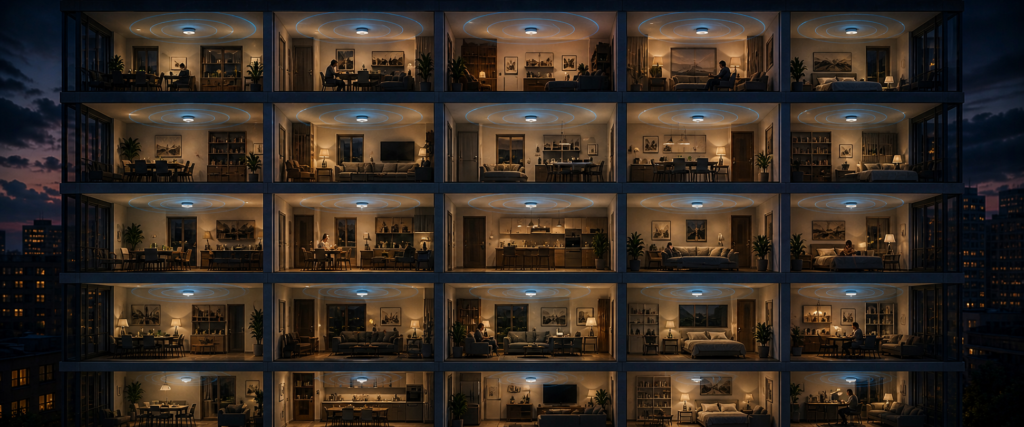 Internet Subway’s next-generation managed Wi-Fi is built around this reality. We do not treat Wi-Fi as a bunch of individual routers fighting each other inside the same building. We treat it as property infrastructure.
That means coordinated design, managed access points, smarter channel planning, better power control, segmented resident networks, monitoring, and support that understands the building and the intended user experiences. It also means introducing 6GHz into the resident experience. Compatible devices get access to cleaner, higher-capacity spectrum, which improves the experience for newer devices and helps reduce congestion in the 5GHz and 2.4GHz bands that are carrying too much of the load today.
For residents, that means better performance where they actually use it: work calls, streaming, gaming, phones, laptops, and smart home devices. For owners, it means fewer complaints, a more consistent resident experience, and a network designed for how apartment communities actually operate.
Multifamily Wi-Fi is not just a bandwidth problem. It is a coordination problem. We treat it that way and solve accordingly.
Sources
Optimizing Wi-Fi Channel Selection in a Dense Neighborhood
Yonatan Vaizman and Hongcheng Wang, SCTE Technical Journal, vol. 2, no. 3, pp. 61–72, 2022.
https://arxiv.org/abs/2211.03872
Wi-Fi Spectrum: 6GHz Use Is Surging and Headed Toward Exhaustion
CableLabs, May 20, 2025.
https://www.cablelabs.com/blog/wi-fi-spectrum-6-ghz-use-surging-headed-toward-exhaustion
FCC Opens 6GHz Band to Wi-Fi and Other Unlicensed Uses
Federal Communications Commission, April 23, 2020.
https://www.fcc.gov/document/fcc-opens-6-ghz-band-wi-fi-and-other-unlicensed-uses-0
Unlicensed Use of the 6GHz Band; Expanding Flexible Use in Mid-Band Spectrum
Federal Register, March 6, 2025.
https://www.federalregister.gov/documents/2025/03/06/2025-02962/unlicensed-use-of-the-6-ghz-band-expanding-flexible-use-in-mid-band-spectrum-between-37-and-24-ghz