
A no-fluff guide for multifamily owners and asset managers who want to stop leaving revenue on the table.
Internet is not an amenity anymore. It is infrastructure. It sits right next to water, power, and HVAC on the list of things your residents will not live without.
If a resident’s Wi-Fi drops during a Zoom call, they do not call Comcast first. They call your leasing office. Then they leave a one-star review. Then they do not renew.
You already know this. The question is what to do about it.
Most multifamily owners are choosing between three models: retail internet, bulk internet, and managed Wi-Fi. Each one works differently. Each one hits your NOI differently. And most owners pick the wrong one because nobody explains the tradeoffs in plain English.
This article fixes that.
The Three Models in 60 Seconds
Before we get into the details, here is the short version.
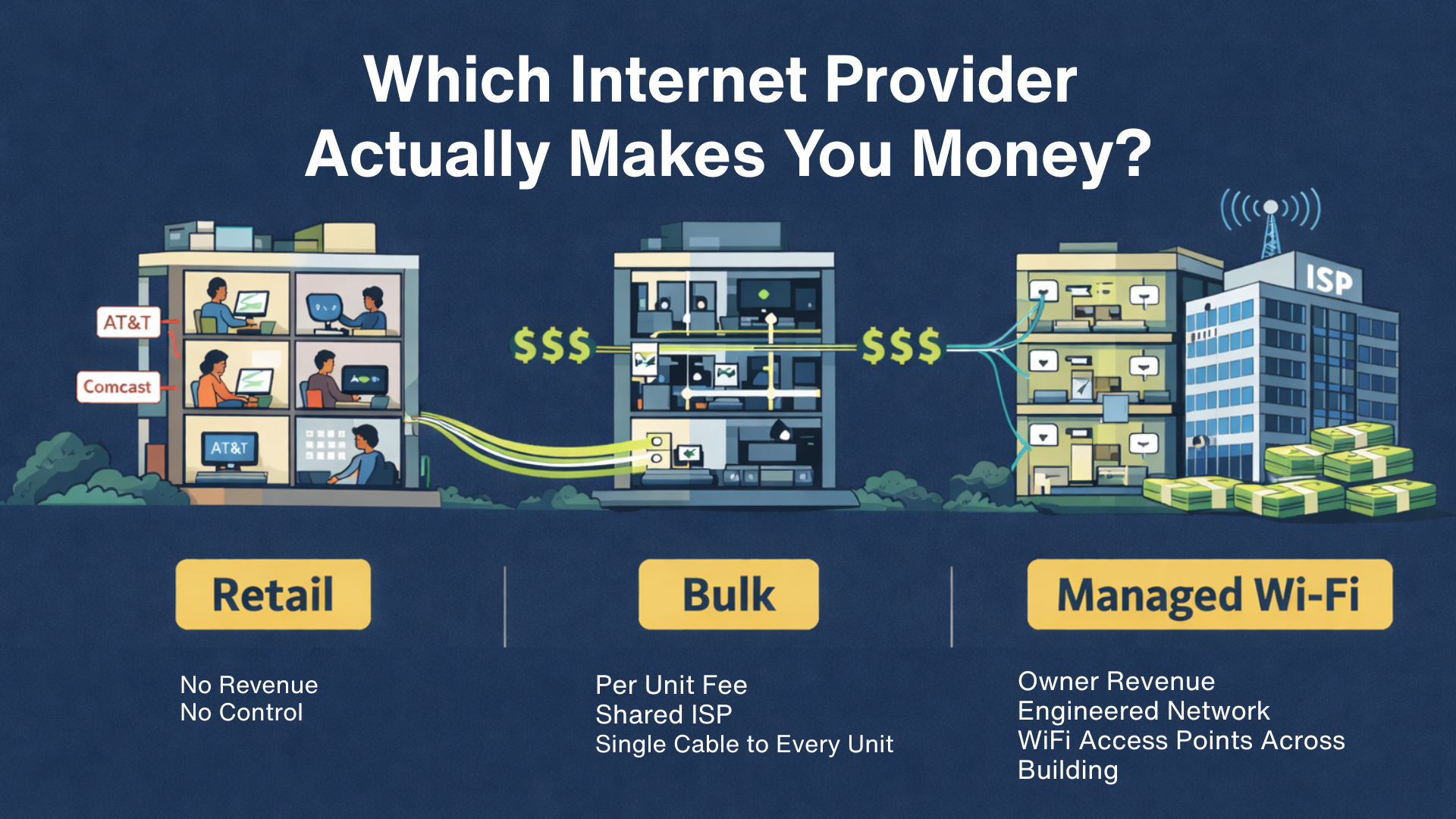
Retail internet means each resident picks their own provider. You stay out of it. They deal with Comcast or AT&T directly. You pay nothing. You also earn nothing. And you have zero control over the experience.
Bulk internet means the property signs one contract that covers every unit. You negotiate a per-unit rate, then recover the cost through rent or a technology package. Better economics. Simpler move-ins. But the network itself can still be hit or miss depending on how it is designed.
Managed Wi-Fi is a property-wide network that is professionally designed, monitored, and supported. Think enterprise-grade connectivity for your entire community. Not hundreds of consumer routers fighting each other for signal. One network. Engineered for density. Backed by real support.
Here is the key distinction most people miss: bulk and retail describe who pays. Managed Wi-Fi describes how the network actually works. You can have bulk billing without managed Wi-Fi. And you can pair managed Wi-Fi with a bulk program to get the best of both.
Retail Internet: The Path of Least Resistance (and Least Revenue)
Retail is the default. Each household signs up with whichever ISP services the building. The owner stays hands-off.
On paper, that sounds great. No cost. No responsibility. No headaches.
In reality, you get plenty of headaches. You just do not get paid for them.
Here is what retail actually looks like on the ground:
- Inconsistent service quality. One unit has fiber. The next unit has DSL. The unit above has a router from 2017 creating interference for everyone around it.
- Move-in friction. New residents wait days or weeks for installation. That first impression matters more than most operators realize.
- Your leasing office becomes a de facto help desk. When the internet does not work, residents complain to you first. Even though you have nothing to do with it.
- Zero revenue. The ISP collects every dollar. You see nothing. Maybe a small revenue-share if you are lucky. Usually not enough to matter.
- Smart building systems suffer. If you are rolling out access control, package lockers, cameras, or smart thermostats, a fragmented network makes everything harder to manage.
Retail works for owners who want to stay completely hands-off. But “hands-off” does not mean “problem-free.” It just means the problems are someone else’s fault while still showing up in your reviews and renewal rates.
Bulk Internet: Better Economics, but Execution Matters
Bulk internet is a step up. You negotiate one deal. You get volume pricing. You pass the cost through to residents.
The math can work well. According to research from the National Multifamily Housing Council (NMHC), renters are showing increasing interest in managed connectivity solutions, and the demand for seamless internet from day one continues to climb.
Here is what bulk gets you:
- Negotiating power. One contract across hundreds of units drives the per-unit cost down significantly.
- Marketing advantage. “Internet included” is a real differentiator at lease-up. It removes friction and simplifies the value proposition for prospective residents.
- Potential NOI lift. When you bundle connectivity into rent or a technology package, you can recapture cost and potentially increase effective rent. Commentary from the Fiber Broadband Association has noted that renters may pay a meaningful premium for fiber-enabled units.
- Simpler move-ins. Residents walk in. Internet works. No scheduling installs. No waiting for equipment.
But bulk has a catch. If the underlying network is poorly designed, you are just bulk-buying a bad experience. Bulk bandwidth with resident routers still means interference, dead zones, and inconsistent performance. You have locked in the cost without locking in the quality.
That is where managed Wi-Fi comes in.
Managed Wi-Fi: Consistent Performance, Engineered for Density
Managed Wi-Fi is what happens when you treat connectivity like a building system instead of a resident problem.
Instead of hundreds of individual routers competing for airtime, a managed Wi-Fi solution uses strategically placed access points, centralized monitoring, and proactive maintenance. The network is designed for your specific building. High-rise concrete construction gets a different design than garden-style wood-frame. Because the radio environment is completely different.
Here is what a well-executed managed Wi-Fi program delivers:
- Reliability. The network is monitored around the clock. Issues get caught before residents notice them.
- Security. Network segmentation means one household cannot see another household’s devices. Published guidance from the National Institute of Standards and Technology (NIST SP 800-153) outlines best practices for securing wireless LANs through proper design, configuration, and monitoring.
- Reduced operational burden. Your onsite team stops fielding internet complaints. The provider handles support, troubleshooting, and resident onboarding.
- Smart building foundation. Access control, cameras, leak sensors, smart thermostats — all of these run better on a unified, managed network.
- Resident satisfaction. Consistent, fast Wi-Fi everywhere. In-unit, at the pool, in the clubhouse, in the coworking space. One seamless experience.
The tradeoff is cost. Managed Wi-Fi runs higher than basic bulk bandwidth because you are paying for hardware, design, monitoring, and support. But when you factor in fewer complaints, faster lease-ups, better retention, and the ability to support premium rent — the math usually works.
What Multifamily Owners and Asset Managers Should Actually Evaluate
Forget the sales pitch. Here is what matters when you are comparing options.
Start with your building, not the brochure. Unit count, construction materials, building layout, and existing infrastructure all affect what is possible and what it costs. A 1970s concrete mid-rise and a 2020 wood-frame garden community need completely different network designs.
Know your residents. Work-from-home density, device counts, streaming habits, and expectations vary by demographic. Student housing and luxury lease-ups have different requirements. Design for the residents you have, not a generic template.
Ask about SLAs. This is where most evaluations fall apart. Ask every provider the same questions:
- What is your uptime guarantee?
- Who answers the phone when a resident has an issue? Is it 24/7?
- How do you handle moves, transfers, and unit turns?
- What reporting do owners get? Uptime, utilization, resolution times, heat maps?
- Do residents get their own credentials and network segmentation?
Understand the regulatory landscape. The FCC has taken steps to improve competition in multi-tenant environments, including rules around revenue-sharing and disclosure of exclusive marketing arrangements. You can review the details in the Federal Register summary of FCC 22-12. Understand these rules before you sign anything.
Model the financials honestly. Look at CapEx vs. OpEx. Model the revenue recovery. Factor in the impact on renewal rates, lease-up velocity, and resident satisfaction scores. The cheapest option on paper is not always the cheapest option in practice.
A Quick Decision Framework
If you need a rule of thumb, here it is:
- Retail is simplest for the owner in the short term but creates the most variability in resident experience and leaves revenue on the table.
- Bulk improves economics and simplifies move-ins but requires a thoughtful rollout and clear communication with residents.
- Managed Wi-Fi delivers the most consistent experience when it is designed correctly and backed by real operational support. It only pays off when the provider is accountable through clear SLAs and transparent reporting.
For most institutional owners and asset managers running 100+ unit communities, the conversation is moving toward managed Wi-Fi paired with bulk billing. The combination gives you scale economics, resident satisfaction, and a platform for smart building systems.
The Bottom Line
Your residents are paying for internet one way or another. The question is whether that money flows through your P&L or goes straight to a legacy ISP that gives you nothing in return.
Insurance costs are up. Fixed expenses keep climbing. Rent growth has flattened in many markets. Connectivity is one of the few levers left where you can add real, measurable revenue to your bottom line while simultaneously improving the resident experience.
That is not a nice-to-have. That is a strategic decision.
If you are evaluating internet options for your portfolio, talk to the Internet Subway team about what a modern connectivity strategy looks like for your specific assets. We will walk the property, model the economics, and give you a straight answer on what makes sense. No fluff. Just numbers and a plan.
Want to learn more about how managed Wi-Fi works at the property level? Check out our managed Wi-Fi solutions page to see how we design, deploy, and support property-wide networks for multifamily communities.
Internet Subway provides bulk internet and managed Wi-Fi solutions for multifamily communities. We handle the design, installation, and ongoing support so owners can focus on what they do best — operating great properties.