
The connectivity decisions that shape a property’s performance are often made long before anyone starts discussing internet service. They happen during planning and design, when pathways, telecom spaces, wiring, ownership rights, and provider access are defined, often without a clear owner responsible for the property’s long-term connectivity strategy. By the time construction is nearing completion, many of the choices that will determine the network’s cost, flexibility, and future performance are already locked in.
For decades, connectivity was treated as a basic utility: if residents could get online after move-in, the project was considered successful. That standard no longer reflects how modern properties operate. Today, connectivity supports resident experience, property operations, building systems, security, access control, smart technology, and nearly every future innovation the asset may adopt. Like electrical, plumbing, and mechanical systems, it is foundational building infrastructure and should be planned accordingly.
Developers who recognize this early deliver projects with fewer construction complications, lower long-term operating costs, greater flexibility for future technology, and stronger asset performance throughout the property’s lifecycle.
Connectivity Is an Asset Planning Decision
Many development teams begin the connectivity conversation by asking which internet provider will serve the property. While that is an important decision, it is rarely the first question that should be asked.
The better question is what the owner wants the property to become over the next ten, fifteen, or twenty years. Is the goal to maximize long-term cash flow? Deliver a premium resident experience? Support evolving smart building technologies? Minimize future capital expenditures? Improve operational efficiency across the portfolio? Every one of these objectives influences how connectivity infrastructure should be designed.
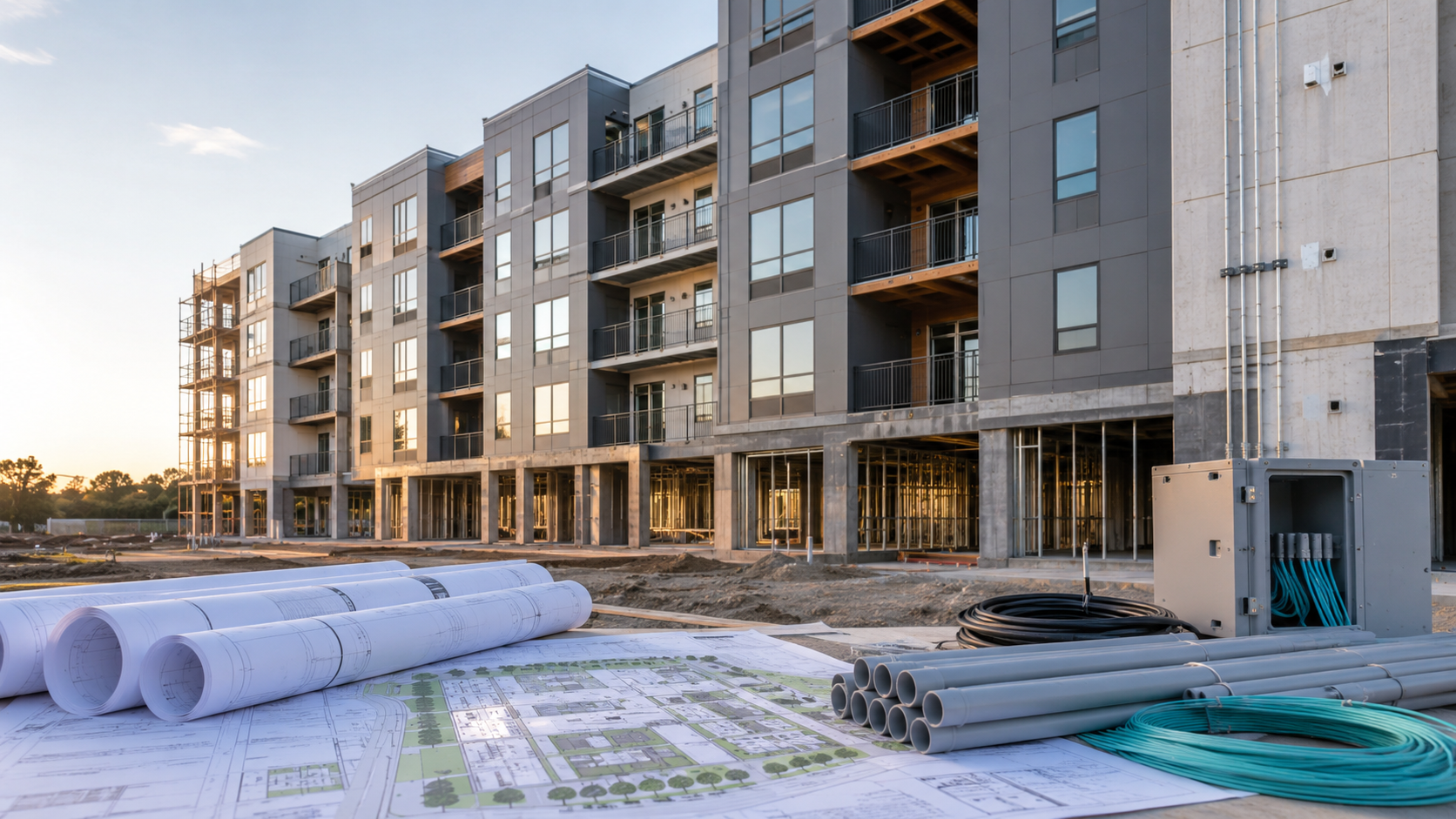
The network is not simply another vendor scope. It becomes part of the building’s permanent infrastructure. Decisions regarding telecom spaces, conduit pathways, fiber distribution, electrical capacity, and in-unit wiring will remain with the property long after the construction team has left the site. Unlike finishes or furnishings, these systems are expensive to modify once construction is complete.
When viewed through the lens of long-term ownership rather than project completion, multifamily connectivity planning becomes an asset strategy rather than a technology purchase.
The Cost of Waiting
Connectivity is frequently addressed during the final phases of construction because it appears to be one of the last systems needed before residents move in. Unfortunately, that timing often creates unnecessary complexity.
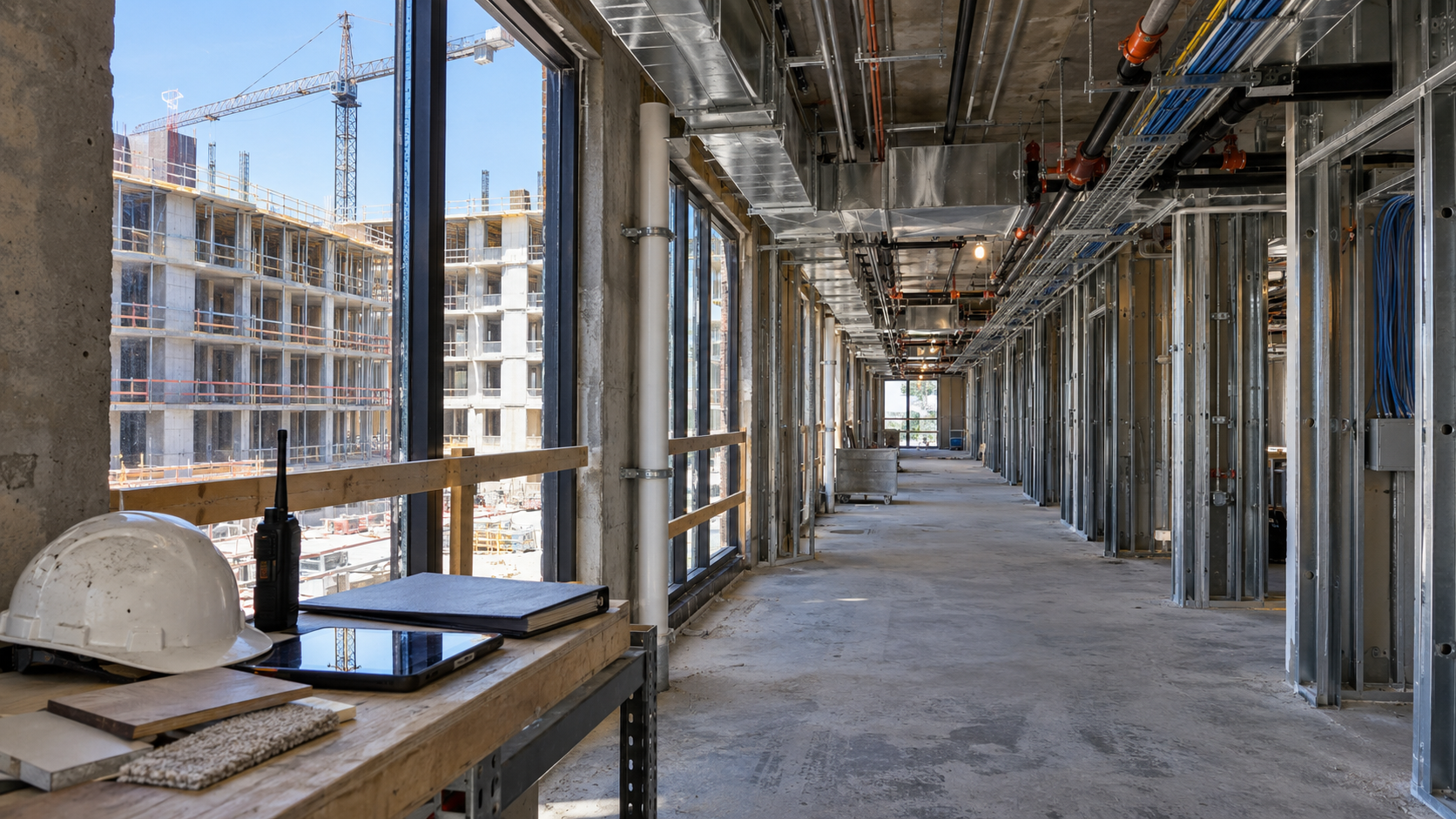
Architectural drawings have already been finalized. Structural elements have been installed. Electrical pathways have been coordinated. Concrete has been poured. Walls have been framed and insulated. At that point, changing infrastructure becomes significantly more expensive than designing it correctly from the beginning.
The consequences are familiar across the industry. Telecom rooms are undersized or poorly located. Conduit pathways become overcrowded. Fiber routes require redesign. Additional power must be added after electrical rough-in. Multiple contractors become involved in solving issues that could have been prevented during design, resulting in change orders, schedule impacts, and increased costs.
None of these problems are caused by the technology itself. They are caused by planning too late.
Start With Owner Objectives
Every successful development begins with clearly defined business objectives. Connectivity planning should follow the same principle.
Before architects begin designing floor plans or engineers begin laying out building systems, ownership should establish what success looks like over the life of the asset. Those goals often extend far beyond providing internet access.
An owner may want to minimize future capital expenditures by installing infrastructure that can support multiple generations of technology without significant reconstruction. Another may prioritize operational efficiency through centralized building systems and property automation. Others may view connectivity as a competitive advantage that improves resident satisfaction, retention, and lease velocity.
Once these objectives are clearly defined, every design decision becomes easier. The project team can evaluate infrastructure choices against long-term business outcomes rather than short-term construction convenience.
Without that direction, every consultant naturally optimizes for their individual scope instead of the overall success of the asset.
Connectivity Is a Team Sport
No single organization designs, builds, and operates a multifamily community alone. Successful projects depend on coordination among multiple disciplines, each bringing specialized expertise to the development process.
Ownership establishes the vision for the property and defines the long-term operational goals. Architects integrate telecommunications spaces and pathways into the overall building design. Engineers ensure adequate electrical capacity and coordinate low-voltage infrastructure with other building systems. General contractors manage sequencing, coordination, and execution throughout construction. Low-voltage contractors install the physical communications infrastructure according to the project documents.
The connectivity partner plays a different role than any of these participants. Rather than focusing solely on internet service, an experienced connectivity partner should represent the owner’s long-term operational interests throughout design and construction. Their responsibility is to help ensure that infrastructure decisions made today continue supporting the property years after the certificate of occupancy is issued.
When each stakeholder understands both their own responsibilities and how they interact with the broader team, projects move more efficiently and with significantly fewer surprises.
Accountability Is Often the Missing Piece
One of the most common causes of connectivity problems is not poor engineering or poor construction. It is fragmented accountability.
Every participant completes their assigned scope, yet no one owns the complete outcome.
The architect assumes telecommunications requirements have been addressed by engineering. Engineering assumes the selected provider will adapt to the available infrastructure. The internet provider expects pathways and telecom spaces to already exist. The contractor builds according to the plans provided. Each organization fulfills its contractual obligations, yet gaps remain between individual scopes of work.
The result is often a property that technically meets specifications while failing to support the owner’s operational objectives.
Successful developments assign responsibility for the overall connectivity strategy early in the project. Someone should continuously evaluate whether individual design decisions support the owner’s long-term goals rather than simply satisfying individual construction requirements.
Design Infrastructure for Decades, Not Delivery
Construction projects have finite schedules. Buildings do not.
A multifamily community completed today will almost certainly experience multiple generations of networking technology during its lifetime. Internet speeds will continue increasing. Wireless standards will evolve. Building automation systems will become more sophisticated. Security technologies will expand. Resident expectations will continue changing.
The physical infrastructure installed during construction should accommodate those changes without requiring extensive demolition or repeated capital investment.
That requires thoughtful planning of telecom room sizing, conduit capacity, fiber pathways, electrical service, equipment locations, and in-unit infrastructure. None of these investments are particularly visible to residents, but they determine how easily the property can evolve over the next twenty years.
Good infrastructure creates flexibility. Poor infrastructure creates limitations that become increasingly expensive to overcome.
The Network Supports the Entire Property
Modern multifamily communities rely on connectivity for far more than resident internet access.
Access control systems, surveillance cameras, package management, building automation, HVAC controls, water monitoring, energy management, smart locks, resident applications, maintenance systems, and future operational technologies all depend on reliable network infrastructure. As properties continue adopting new digital services, that dependence will only increase.
When connectivity is designed solely to deliver internet service, these systems often develop independently over time. Separate vendors install isolated networks, equipment becomes fragmented, and operational complexity increases with every new technology deployment.
A well-planned network provides a common foundation that supports both resident services and property operations. The result is greater operational consistency, simplified management, and infrastructure capable of adapting as technology continues evolving.
Evaluate Success Over the Entire Ownership Lifecycle
Many projects define success as achieving substantial completion, obtaining a certificate of occupancy, and successfully activating resident internet service. While those milestones are important, they represent the beginning of the property’s operational life rather than the end of the project.
The more meaningful questions arise years later. Can new technologies be deployed without major construction? Does the infrastructure continue supporting resident expectations? Are operational systems reliable and easy to maintain? Have unexpected capital projects been avoided? Has the network continued creating value as the property has matured?
These are the metrics that determine whether connectivity planning was truly successful.
Owners should evaluate connectivity the same way they evaluate every other major building system: by its contribution to long-term operational efficiency, resident satisfaction, risk reduction, and overall asset performance.
Connectivity Is Part of Building the Asset
Connectivity should never be viewed as a finish item that can be addressed shortly before residents move in. It is permanent infrastructure that influences construction coordination, operational efficiency, resident experience, future technology adoption, and long-term financial performance.
Developers already devote significant attention to structural systems, mechanical design, electrical distribution, and life safety because those decisions shape the building for decades. Connectivity deserves the same level of strategic planning. When incorporated early, it reduces construction risk, minimizes change orders, simplifies coordination across project teams, and creates infrastructure capable of supporting the property’s future.
The highest-performing multifamily communities are not simply constructed to meet today’s requirements. They are designed to remain valuable as technology, operations, and resident expectations continue to evolve.
Connectivity is one of the systems that makes that possible. The earlier it becomes part of the development conversation, the greater its impact on the long-term value of the asset.