
A multifamily property can open on schedule, pass every network acceptance test, and have internet working in every apartment. From a construction standpoint, the connectivity project is finished.
That doesn’t necessarily mean ownership got a good long-term investment.
Five years later, the property could be facing an equipment refresh nobody budgeted for, a network upgrade that requires work inside occupied apartments, or a service agreement that makes changing providers more complicated than anyone anticipated. None of those problems would necessarily have prevented the building from opening.
Construction and asset management evaluate success differently. Development teams have to deliver a functioning property within an approved budget and schedule. Asset managers have to understand what that property will cost to operate, maintain, and improve throughout the ownership period.
Connectivity belongs in both conversations.
The problem is that internet service is still frequently evaluated through installation pricing, advertised speeds, and whether residents can get online at move-in. Those details are important, but they don’t tell an owner enough about the infrastructure, financial commitments, and operating responsibilities that come with the network.
An asset manager should be asking a different set of questions.
Looking Beyond Opening Day
During construction, the connectivity checklist is fairly straightforward. Are the pathways installed? Is the network equipment operational? Has the cabling been tested? Can residents activate service? Does the Wi-Fi perform as designed?
Those are legitimate acceptance requirements. They establish that the contractor and provider delivered what was specified.
They don’t establish whether the specifications were appropriate for the property’s long-term needs.
Consider what happens when ownership wants to introduce a new building system several years after opening. Maybe it’s a different access-control platform, a building-wide technology upgrade, or new equipment supporting property operations.
Can the existing infrastructure accommodate it? Is there available pathway capacity? Are there accessible connection points? Does the owner have the necessary rights to use or modify the network?
Those questions often receive less attention than installation cost and opening-day performance.
The handoff from construction to operations also deserves scrutiny. Ownership should receive accurate as-built drawings, equipment inventories, testing records, fiber or cable assignments, and clear information about which components belong to the property and which belong to the provider.
A system can work perfectly when the original installation crew leaves and become unnecessarily difficult to maintain when that crew is no longer available.
For an asset manager, successful turnover means more than an operational network. It means inheriting infrastructure that the next property manager, technician, or service provider can understand.
Thinking in Lifecycle Cost Instead of Initial Cost
Nobody evaluating a major mechanical system would look only at its purchase price. Expected maintenance, energy consumption, useful life, and replacement costs are part of the decision.
Connectivity deserves the same treatment.
Two providers might submit proposals for the same 200-unit development. One offers a lower installation cost and a competitive monthly service rate. The other requires more investment upfront but includes different equipment ownership, maintenance, and replacement provisions.
The first proposal may be the better financial choice. So might the second. You can’t establish that from the installation quote alone.
An asset manager needs to understand what each arrangement will cost over the expected hold.
That means looking at more than the initial construction expense.
| Cost consideration | What ownership needs to establish |
| Initial investment | Installation costs, infrastructure contributions, and any owner-funded equipment |
| Recurring expense | Monthly service charges, annual escalations, minimum commitments, and fees |
| Maintenance | Who pays for repairs, equipment failures, resident support, and service calls |
| Equipment replacement | Which components may need refreshing during the hold and who funds that work |
| Future upgrades | Whether additional capacity requires equipment changes, new cabling, or construction |
| Contract expiration | Early termination obligations, transition costs, and rights to reuse infrastructure |
These categories can look very different depending on the business model.
For example, an owner-owned network may create direct capital obligations when switches or wireless equipment need replacement. Under a managed arrangement, the provider may fund those replacements, with the cost reflected in recurring service payments.
Neither arrangement eliminates the need to understand the underlying expenses.
The same scrutiny should apply to projected revenue. If a proposal includes resident upgrade revenue, revenue sharing, or other financial benefits, ownership should distinguish guaranteed payments from projections that depend on resident adoption.
A ten-year comparison also needs to account for escalation clauses. The monthly rate on the first page of a proposal isn’t necessarily what ownership will be paying in year eight.
And then there’s the cost of working on the building after residents move in.
A pathway omitted to reduce construction expenses can become a much larger project when a future upgrade requires entering apartments, opening walls, restoring finishes, and coordinating around residents.
Those potential costs may not appear in either provider’s initial installation estimate, but they belong in the investment analysis.
The objective isn’t automatically to spend more during construction. It’s to understand what each decision commits the property to spending later.
What Flexibility Is Worth When the Building Needs to Change
Buildings rarely operate for twenty years with exactly the same technology they had at opening.
Resident expectations change. Property operations adopt new systems. Network electronics improve. Ownership may change providers or decide to offer different services.
The ability to make those changes without reconstructing finished infrastructure is worth evaluating before construction.
Start with a basic question: where does the fiber stop?
In one property, fiber may reach the main network room, with copper cabling connecting equipment in intermediate closets to the apartments. In another, fiber may extend directly to every residence.
Both designs can deliver excellent service. They don’t create identical options for future upgrades.
Fiber to the Unit (FTTU) gives the building a high-capacity physical connection to each apartment that may support multiple generations of network electronics. That doesn’t guarantee compatibility with every future technology, but it can reduce the need to replace in-wall cabling as service requirements change.
Network architecture matters separately. A passive optical design can distribute fiber through intermediate closets without placing powered Ethernet switches in those locations. An active Ethernet design has different equipment, power, and maintenance requirements.
The owner should understand those differences rather than treating every proposal described as fiber internet as equivalent.
Pathways are just as important.
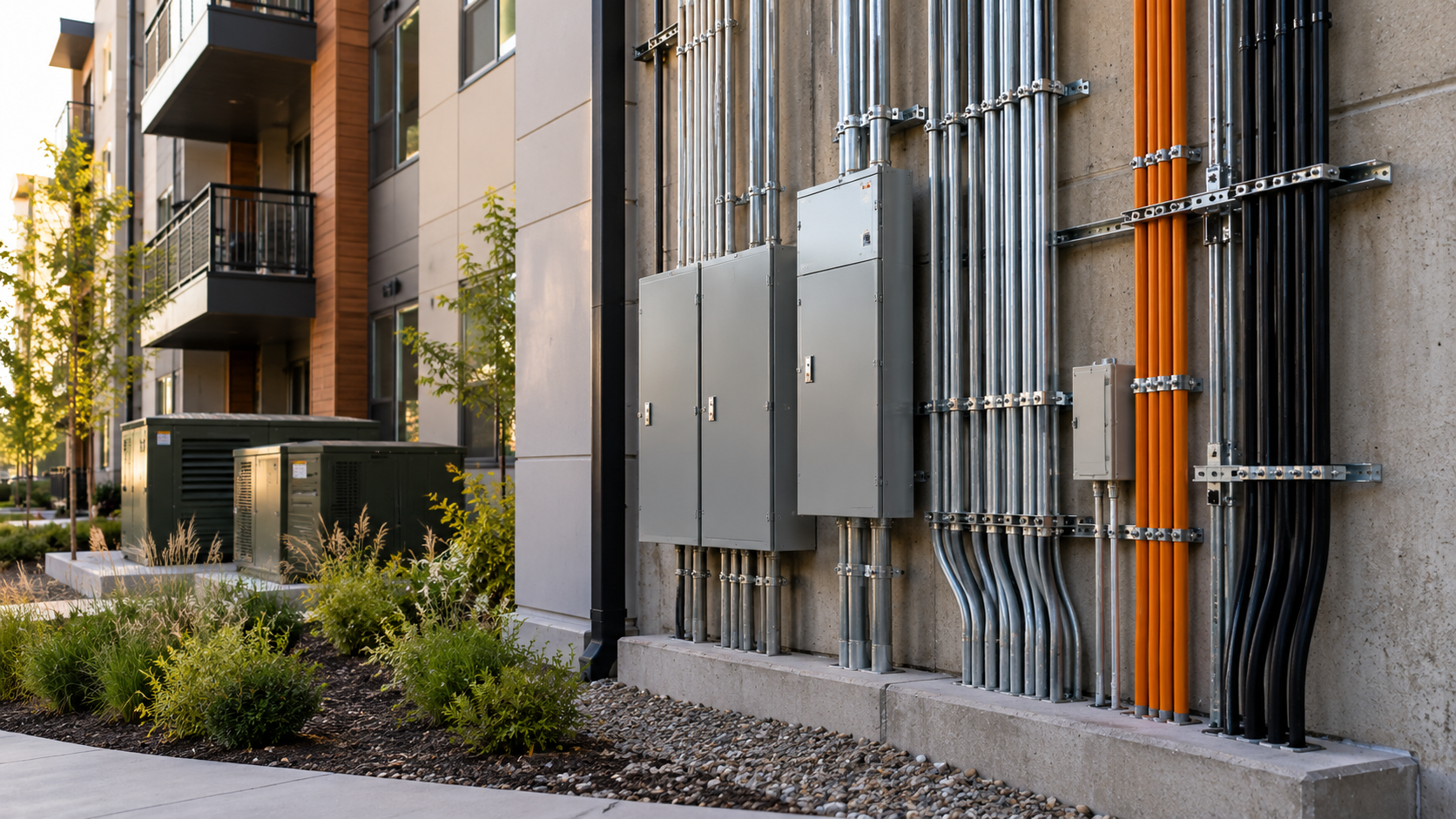
An accessible conduit or microduct route can provide a way to repair or replace cabling without automatically opening finished walls. Spare capacity in risers, appropriately sized telecommunications rooms, and documented connection points can also make future work easier.
None of these features eliminates the need for future investment. They give ownership more ways to make that investment without unnecessarily disturbing the building.
That flexibility may never be fully used during the current ownership period. It can still be valuable when evaluating an upgrade, negotiating with a different provider, or preparing the property for a sale.
A buyer assessing future capital requirements would rather know the building has accessible, documented pathways than discover that its communications infrastructure cannot be modified without substantial construction.
Operational Simplicity Has Real Economic Value
Some of the most consequential connectivity decisions have little to do with internet speed.
Who handles a resident who cannot activate service? Who diagnoses a failing access point? Who replaces equipment inside an apartment? Does the provider work directly with residents, or does the property manager have to coordinate every support request?
The answers determine how much responsibility lands on the property’s operating team.
A managed network can reduce that burden when service responsibilities are clearly established and the provider has the systems to support residents directly. But a contract described as fully managed doesn’t automatically tell ownership where every responsibility begins and ends.
Those details need to be worked out before the property opens.
The physical installation has operational consequences, too.
Imagine a technician responding to a connectivity problem in apartment 214. The telecom closet is accessible, but the cabling isn’t labeled consistently and the network documentation doesn’t match the installed connections.
The technician now has to spend time identifying the correct route before addressing the original problem. If the property changes providers or maintenance contractors, that uncertainty follows the next team.
Accurate labeling, organized telecommunications rooms, accessible equipment, and current documentation won’t prevent every service issue. They make problems easier to diagnose and reduce the amount of time spent figuring out how the building was wired.
For ownership, the economic consequences can include technician labor, unnecessary site visits, prolonged service interruptions, and additional work for property staff.
Those costs won’t always justify a separate line in an acquisition model, but recurring support problems can be evaluated through service records, response times, trouble-ticket history, and the responsibilities assigned to the onsite team.
An asset manager should want to know how the network will be operated, not just how it will be installed.
Risk Extends Far Beyond Technology
Connectivity risk is usually discussed in terms of outages, equipment reliability, cybersecurity, and capacity. Those are legitimate concerns, but an asset manager has a broader set of exposures to evaluate.
Technical risk involves the infrastructure itself. Is the equipment still supported? Does the installed cabling perform as intended? Is there enough capacity for the property’s requirements? What components are likely to need replacement?
Operational risk concerns the people and processes required to maintain service. Are responsibilities clearly assigned? Can technicians access equipment? Does property management have a reliable escalation process? Are the records accurate enough for someone unfamiliar with the original installation to troubleshoot the system?
Commercial risk is different again.
Who owns the fiber, pathways, switches, and terminal equipment? Can ownership authorize another provider to use that infrastructure? What happens if the current provider is acquired, the property sells, or the service agreement expires?
A property can have a technically excellent network and still face difficult contractual restrictions. It can also have older equipment that remains perfectly serviceable under an agreement that provides for maintenance and replacement.
Those are very different ownership situations.
Consider a property approaching the end of a long-term managed Wi-Fi agreement. The existing service works, but ownership wants to evaluate competing providers.
If the current provider owns the network infrastructure, the buyer or owner needs to understand whether that equipment can be purchased, transferred, reused, or must be replaced. Even when the property owns the fiber, missing documentation or restrictions on access may complicate a transition.
A new provider may also require different electronics or modifications to the existing optical distribution system.
These questions are easier to address when the original agreement is negotiated than when its expiration is approaching.
They matter during acquisitions and refinancing, too. A buyer inheriting several years of contractual obligations should understand the remaining costs, service commitments, ownership rights, and likely capital requirements.
Network engineering, property operations, and legal review each address different parts of that risk. Asset management has to consider the combined result.
Connectivity Should Support the Investment Strategy
The right connectivity investment depends partly on what ownership intends to do with the property.
A developer planning to sell shortly after stabilization may place particular importance on clean documentation, clear infrastructure ownership, transferable agreements, and avoiding unresolved obligations that create questions during buyer diligence.
A long-term owner may be more focused on maintenance responsibility, recurring service expenses, equipment replacement cycles, and the ability to introduce new technology without major construction.
An owner acquiring an existing property has yet another starting point. Before approving an upgrade, the asset team should understand what infrastructure is already installed, what condition it’s in, who controls it, and which parts can reasonably be reused.
These strategies can lead to different decisions, even when the properties have similar resident connectivity needs.
That’s why I would want an asset manager involved before a major connectivity proposal is approved, particularly when the project includes permanent infrastructure or a long-term service commitment.
The investment review should establish the expected cost over the ownership period, identify which party maintains and replaces the equipment, and explain what changes the existing pathways and cabling can accommodate. It should also address what happens if the property sells or the service relationship ends.
If two proposals offer similar resident service, the distinction may come down to the obligations ownership retains and the choices available later.
That is information worth having before selecting a provider.
A network that works on opening day has satisfied an important construction requirement. But ownership will be dealing with the infrastructure, the operating arrangements, and the agreement long after the installation team leaves.
The asset-management question is what it will cost to keep that network useful throughout the hold, and how much freedom the property will have when something needs to change.
Those answers belong in the investment decision, not in a conversation that happens five years after the contract is signed.