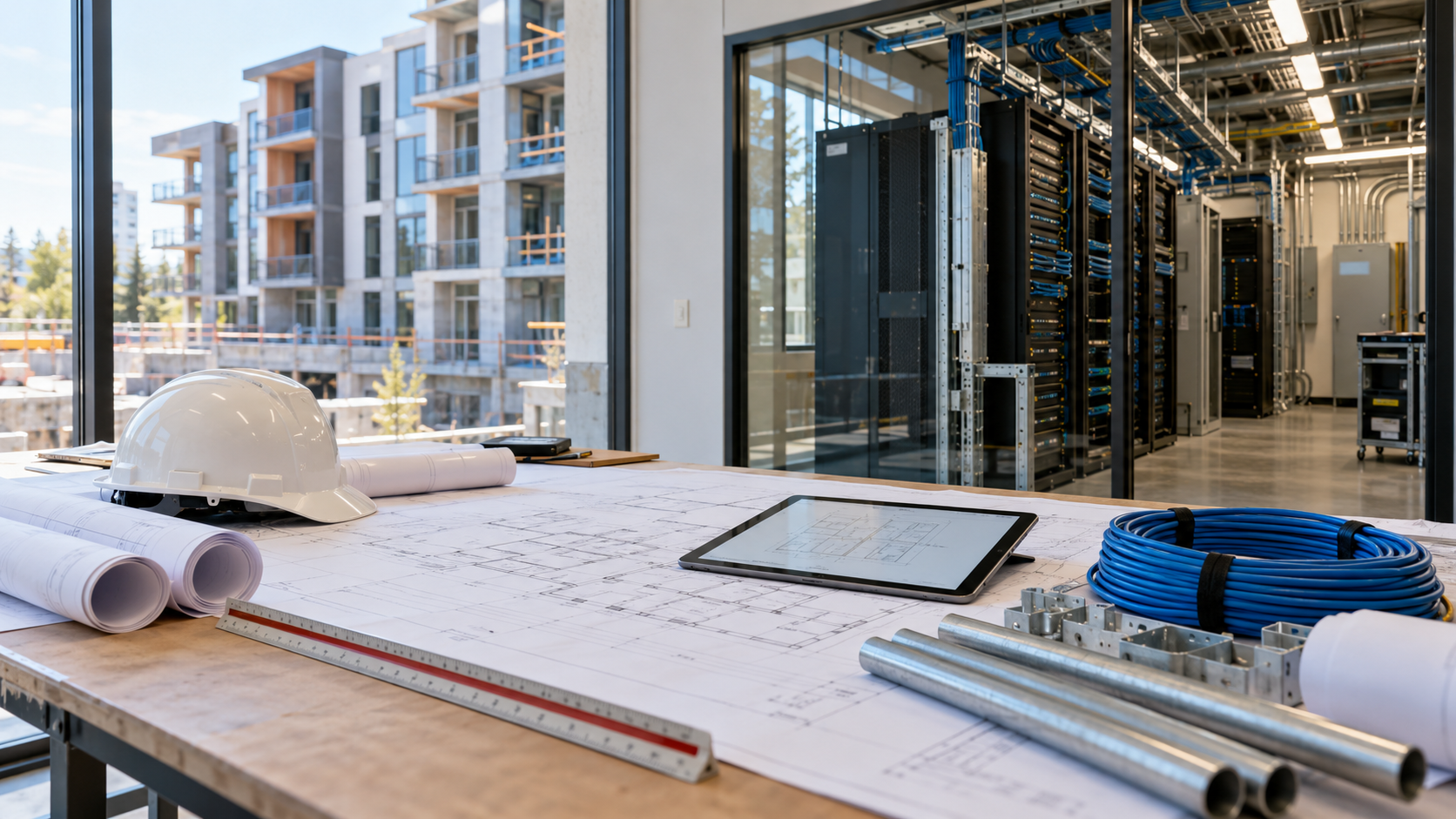

Design reviews are often used to confirm that drawings are complete, specifications align, equipment schedules are accurate, and open coordination items have been resolved.
Those checks are necessary, but they only answer whether the project is ready to move forward.
For multifamily communications infrastructure, a stronger review asks an additional question:
Is the building being prepared to support ownership long after the current project team is gone?
That distinction matters because many of the decisions with the greatest long-term impact can look perfectly reasonable within the context of the current design.
A telecommunications room may fit the initial equipment but leave little room for expansion. A backbone pathway may support the first installation while making future modernization difficult. Documentation may technically satisfy the contract without giving future owners enough information to understand what was built.
Those issues are easier to identify when a multifamily connectivity design review is organized around the long-term performance of the asset rather than the completeness of individual drawings.
Review Lens 1: Permanence
The first question is whether a decision affects short-lived technology or the permanent fabric of the building.
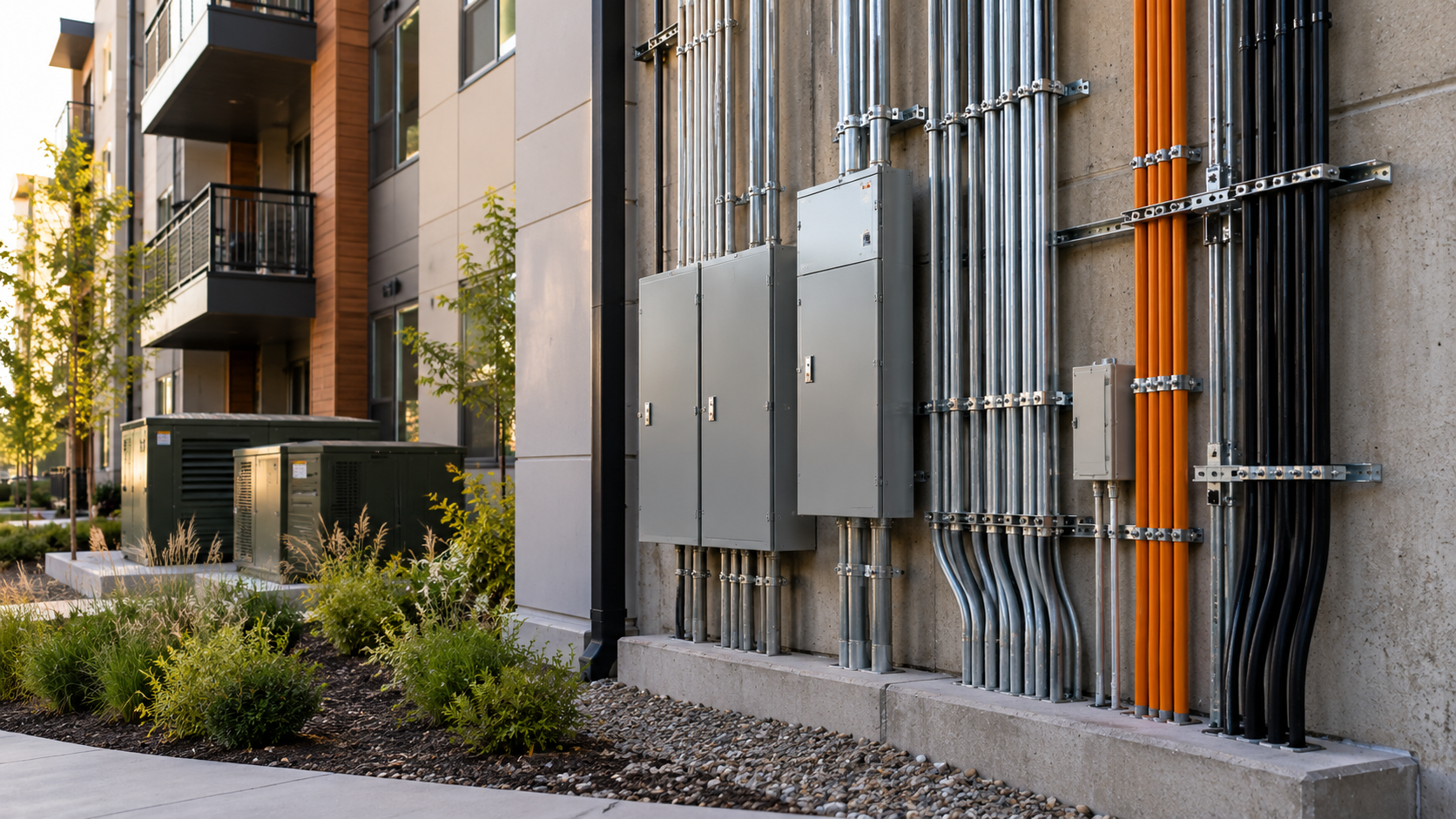
Telecommunications rooms, conduit, risers, backbone pathways, utility entrances, equipment clearances, electrical capacity, and physical access are difficult to change once construction is complete.
Network electronics, wireless platforms, and software are comparatively easy to replace.
That difference should influence design priorities.
Permanent infrastructure should not be compromised to accommodate a temporary technology choice.
This distinction helps project teams focus their attention where mistakes are hardest to recover.
A decision that can be corrected by replacing equipment carries a very different long-term consequence than one that requires opening walls, adding pathways, relocating telecommunications rooms, or modifying occupied building space.
Key question: If this decision proves inadequate ten years from now, can ownership correct it by replacing technology, or will the building itself need to be modified?
Review Lens 2: Flexibility
Every multifamily project is designed around current requirements, but the building will almost certainly support different technologies and operating models over its lifetime.
Connectivity design review should therefore evaluate whether the infrastructure preserves enough flexibility to accommodate change without requiring unnecessary reconstruction.
Reserve pathway capacity, usable telecommunications spaces, accessible routes, available power, and reasonable expansion provisions all contribute to that flexibility.
None of those elements requires the project team to predict exactly what technology will be installed in the future.
The goal is to avoid making permanent decisions that unnecessarily narrow the choices available to future owners.
Flexibility has value precisely because the future cannot be specified in detail during design.
Key question: Does this decision preserve future options, or does it permanently narrow them?
Review Lens 3: Coordination
Connectivity depends on far more than the communications drawings themselves.
Telecommunications rooms affect architectural layouts. Pathways interact with structural conditions. Equipment depends on electrical and environmental support. Outside plant infrastructure must coordinate with civil design. Operational technologies may intersect with access control, surveillance, parking, building automation, elevators, and other systems.
A design can therefore be technically complete within one discipline and still create problems when viewed across the building as a whole.
Strong multifamily connectivity reviews examine those interfaces before the project reaches the point where one system has to work around decisions already finalized by another.
This is also why connectivity review should not occur in isolation.
Architecture, structure, MEP systems, civil engineering, low-voltage design, operations, and technology teams all influence different parts of the finished infrastructure.
Key question: Has this infrastructure been coordinated with the building systems and disciplines it depends on?
Review Lens 4: Operations
Some design decisions create no obvious difficulty during construction but cause recurring problems once the property is occupied.
Equipment that is difficult to access, congested pathways, inadequate working clearances, inconsistent labeling, or poorly organized telecommunications rooms may not prevent installation.
They can, however, make future maintenance, troubleshooting, upgrades, and modernization considerably more difficult.
Connectivity design review should therefore consider the people who will eventually operate the property.
Those teams will troubleshoot systems, coordinate providers, replace equipment, support new technology, and work within the physical conditions established during development.
Including an operational perspective can reveal issues that are easy to overlook when the design is evaluated only for constructability.
The goal is not simply to make the infrastructure installable.
It is to make it manageable after installation.
Key question: Will future operations teams be able to access, understand, and maintain this infrastructure without unnecessary complexity?
Review Lens 5: Documentation
Physical infrastructure and the information describing it should be reviewed together.
A well-designed system becomes much harder to manage if future teams cannot determine where pathways run, how fiber is assigned, what equipment was installed, or which changes were made during construction.
Design reviews should therefore establish what information ownership expects to receive and how accurately that information will describe the completed property.
That may include:
- As-built drawings
- Pathway records
- Fiber schedules
- Equipment inventories
- Labeling standards
- Testing results
- Operating information
- Access procedures
- Infrastructure ownership boundaries
These records should be treated as part of the finished asset rather than as administrative paperwork.
This becomes increasingly important as personnel, contractors, providers, and ownership change over time.
The infrastructure should remain understandable without requiring access to the people who originally designed or installed it.
Key question: If the original project team were no longer available, would the documentation still allow ownership to understand the system?
Review Lens 6: Stewardship
The final review lens considers what happens after turnover.
Communications infrastructure will continue changing as equipment is replaced, new systems are introduced, renovations occur, providers change, and future owners make different operating decisions.
The design should make responsible stewardship easier by establishing clear standards for access, organization, labeling, documentation, and future modifications.
A building that depends on every future contractor making perfect decisions will eventually become difficult to manage.
Strong infrastructure provides a framework that helps later work remain consistent with the original intent.
That allows the quality of the system to be preserved even as the technology occupying it changes.
Key question: Does the design make it easier for future teams to maintain and improve the infrastructure responsibly?
Applying the Framework During Multifamily Connectivity Design Review
The value of these review lenses is not that they create more comments.
Their value is that they change what the project team is looking for.
A traditional design review may confirm that a telecommunications room meets the current equipment requirements.
A permanence and flexibility review asks whether that room will remain useful when the equipment changes.
A coordination review asks whether power, access, structure, and environmental support have been resolved.
An operations review asks whether the room will remain practical to work in after years of additions, replacements, and modifications.
A documentation review asks whether future teams will know what was actually installed.
A stewardship review asks whether the design gives those future teams a clear framework for maintaining the infrastructure responsibly.
The same approach can be applied to pathways, utility entrances, risers, backbone infrastructure, power, labeling, testing, and turnover requirements.
Looking at each decision through several lenses exposes problems that may not appear when the disciplines are reviewed independently.
A Practical Multifamily Connectivity Design Review Checklist
| Review Lens | What to Examine | What the Review Should Confirm |
| Permanence | Telecommunications rooms, pathways, risers, utility entrances, clearances, power | Permanent building decisions will not need to be rebuilt when technology changes |
| Flexibility | Reserve capacity, expansion space, accessible routes, available power | Future owners retain reasonable options for modernization and provider changes |
| Coordination | Architecture, structure, MEP, civil, low voltage, operational systems | Connectivity requirements are integrated with the systems they depend on |
| Operations | Access, organization, maintainability, labeling, working conditions | Future teams can service and modify the infrastructure efficiently |
| Documentation | As-builts, schedules, inventories, test records, labeling standards | Ownership will receive reliable information that reflects actual conditions |
| Stewardship | Governance standards, modification procedures, infrastructure ownership | Future projects can be completed without degrading the quality of the underlying system |
The checklist should be used throughout design rather than saved for a final review.
Permanence, flexibility, telecommunications room locations, and space planning deserve attention during schematic design.
Detailed coordination, power, environmental requirements, access, documentation standards, testing expectations, and turnover requirements become increasingly important as the project develops.
Using the framework repeatedly also helps project teams identify when an earlier assumption is beginning to create a downstream constraint.
The objective is to address those issues while the design still has room to respond.
Review the Building, Not Just the Drawings
An effective multifamily connectivity design review does more than confirm that the current project can be constructed.
It evaluates whether the decisions being made today will leave ownership with infrastructure that remains useful after the construction schedule, the original equipment, and even the original project team are no longer relevant.
That requires looking beyond individual details and considering permanence, flexibility, coordination, operations, documentation, and stewardship together.
Each lens addresses a different source of long-term risk, but collectively they answer the same question:
Is this design creating communications infrastructure that the property can continue to use, understand, maintain, and improve over time?
The best review process does not simply identify errors.
It helps the team protect the decisions that will determine how adaptable, maintainable, and understandable the building remains throughout its life.