
Affordable housing does not need a stripped-down version of internet service. It needs a model that actually fits how affordable housing works. That matters because most multifamily internet programs were not built around LIHTC, workforce, or mixed-income communities. They were usually built around either a traditional carrier relationship or a market-rate bulk internet structure. Both can work in the right setting, but neither automatically translates to affordable housing. Rent growth is constrained, resident affordability matters, site teams are stretched, and every added monthly charge has to be justified.
The issue is not that affordable housing residents do not need strong internet. They do. Internet is how people work, apply for jobs, attend school, use telehealth, stream, communicate, and manage normal daily life. The issue is that the standard structure often does not work well enough for the resident, the site team, or the owner. A better model has to make activation easy, give residents a service they will actually use, avoid dumping work onto the leasing office, and create economics that make sense for the asset.
Broadband in affordable housing should not be treated as a compliance checkbox or a generic amenity. It is part of the operating infrastructure of the property.
Why the Traditional Retail Model Often Falls Short
Traditional carrier models usually start with the subscriber. The provider wants to reach residents, sell individual accounts, and control the customer relationship. That can be fine for the carrier, but it often leaves the owner with very little control over the resident experience or the value being created at the property. The leasing office has limited visibility. Residents manage their own accounts. Move-in connectivity depends on the carrier’s process. Common-area Wi-Fi, access control, cameras, package systems, and other building technology may end up depending on separate circuits, separate vendors, or a patchwork of legacy decisions.
That is not a great outcome for any multifamily property, but it is especially limiting in affordable housing. These communities need a service that works inside tighter constraints. Residents need something affordable and reliable. The property team needs less friction, not another support burden. Owners need a structure that can support the asset without forcing the community into a model that does not fit. This is the core idea behind Why Affordable Housing Needs a Different Internet Model, which looks at Palmer’s Creek Phase II as a real example of what can happen when the model is designed around the property instead of forced onto it.
The Base Service Has to Be Good Enough
One of the biggest mistakes in affordable housing connectivity is assuming the base service can be weak because the property is affordable. That thinking misses the point. If the base tier is not useful, residents do not trust the program. If it feels like a low-end substitute for “real internet,” adoption suffers. A base internet package should be good enough for normal household life: streaming, video calls, schoolwork, remote work, gaming, and everyday use. For many residents, that does not require multi-gigabit service on day one, but it does require a real connection that feels dependable.
At Palmer’s Creek Phase II, every unit was offered a 500 Mbps base package, with the option to upgrade to 1 Gbps, 2.5 Gbps, 5 Gbps, and 8 Gbps. The important part is not only the speed. It is the structure. Residents could create credentials before move-in and connect when they arrived. No technician appointment. No four-hour window. No leasing office trying to help a resident navigate a cable company call center during move-in.
That is a very different resident experience. Internet becomes part of the move-in process instead of a separate hassle the resident has to solve after getting the keys. At Palmer’s Creek Phase II, 95% of residents chose Internet Subway even though the program allowed residents to opt out. Twenty-seven percent upgraded above the 500 Mbps base tier, compared with an industry benchmark of roughly 10% in similar environments. That proof point is covered in more detail in the first article on the affordable housing internet model, but the takeaway is simple: residents will choose better internet when the structure is built around them.
The Owner Economics Matter
Resident experience is only half the conversation. For the model to work, the owner economics have to work too. That does not mean overcharging residents or trying to squeeze more out of a community that is already price-sensitive. It means structuring the program so the property can participate in value that is already being created on-site. Residents are already buying internet. Carriers are already monetizing the property. The question is whether the owner has a model that captures some of that value while also improving the resident experience.
At Palmer’s Creek Phase II, the 200-unit property generates roughly $80,000 of annual NOI through the connectivity model. At standard multifamily valuation assumptions, that represents about $1.6 million in created asset value from one property. At portfolio scale, the impact becomes more meaningful. The same general model across 1,200 units can produce roughly $500,000 in annual NOI and about $10 million in created value. Across 5,000 units, it can produce approximately $2.1 million in annual NOI and about $42 million in created value.
That is why this should not be viewed as a small amenity decision. It is an asset strategy decision.
The structure matters because not every owner is optimizing for the same thing. Some owners may want to fund and own the infrastructure directly. That can be the cleanest long-term margin structure and may make sense for owners with available capital, a long hold period, and a desire to treat the network like core property infrastructure. Others may prefer Network as a Service, where Internet Subway deploys and operates the network while the owner preserves capital and still participates in the upside. In some LIHTC situations, a multi-year prepayment structure may make the most sense because it can reduce ongoing network costs and allow the property to offer residents a lower monthly price.
There is no single structure that fits every affordable housing property. A new construction LIHTC deal, a stabilized workforce housing asset, and a long-held portfolio retrofit may all need different answers. The right model should follow the property, the capital stack, the resident base, and the owner’s goals.
This Is Also a Property Operations Conversation
The internet conversation often starts with residents, but it should not end there. Once a modern network is in place, it can support much more than in-unit service. Most properties are already adding more technology. Access control, cameras, leak detection, package systems, thermostats, energy management, common-area Wi-Fi, and other operational tools all need reliable connectivity. When each system depends on its own connection or vendor-managed network, the property becomes harder to operate over time. Costs get scattered. Troubleshooting gets messy. The site team has less control.
A better network creates a cleaner foundation. It gives the property a platform that can support residents and operations at the same time. That is important for any multifamily asset, but it is especially important in affordable housing because these properties are long-term by design. LIHTC communities are not three-year technology decisions. They have long compliance periods, extended use periods, and ownership strategies that often stretch across decades.
That is one reason underbuilding the network is risky. A 500 Mbps or 1 Gbps service may be more than enough for many residents today, but the property is not being built only for today. Speeds that feel premium now will become standard later. The network should be able to move from 500 Mbps to 1 Gbps, then to 2.5 Gbps, 5 Gbps, or more as expectations change. The owner should not have to rebuild the property’s connectivity foundation every time the market moves.
Implementation Is A Differentiator
Even if the resident model and owner math are strong, the rollout still has to work at the property. That is usually where owners get nervous, and for good reason. A bad rollout can create resident complaints, site team frustration, access issues, construction problems, and confusion around existing carrier agreements.
How Owners Can Implement Better Internet Without Creating a Mess focuses on this practical side of the work. It is an important piece because affordable housing owners do not need another generic internet pitch. They need to know what the first steps look like, where the risks are, and how the project can be managed without overwhelming the property.
For an existing property, the starting point is not fiber design. It is contract review. Who already has rights at the property? Are there marketing agreements, easements, wiring rights, renewal windows, or restrictions that affect timing? Many owners know who the incumbent provider is, but they may not have looked closely at the actual telecom agreement in years. That review often defines what can be done now, what has to be timed around a current agreement, and where the owner may have more flexibility than expected.
After that, the work moves to the property itself. A garden-style community, mid-rise building, scattered-site asset, and new construction project are not the same design problem. The network plan has to account for existing pathways, telecom rooms, available power, fiber routes, resident access, construction phasing, and how the site team will be protected from unnecessary disruption.
The cleanest retrofit is usually not a forced hard cutover. In many cases, the better path is to bring the new network online, make the resident offer clear, and allow adoption to build because the service is better. The property team should not become tech support, an installation scheduler, or the middleman between residents and the ISP. Their job is to run the property. The network operator’s job is to make connectivity work in the background.
New Development Is the Best Time to Get It Right
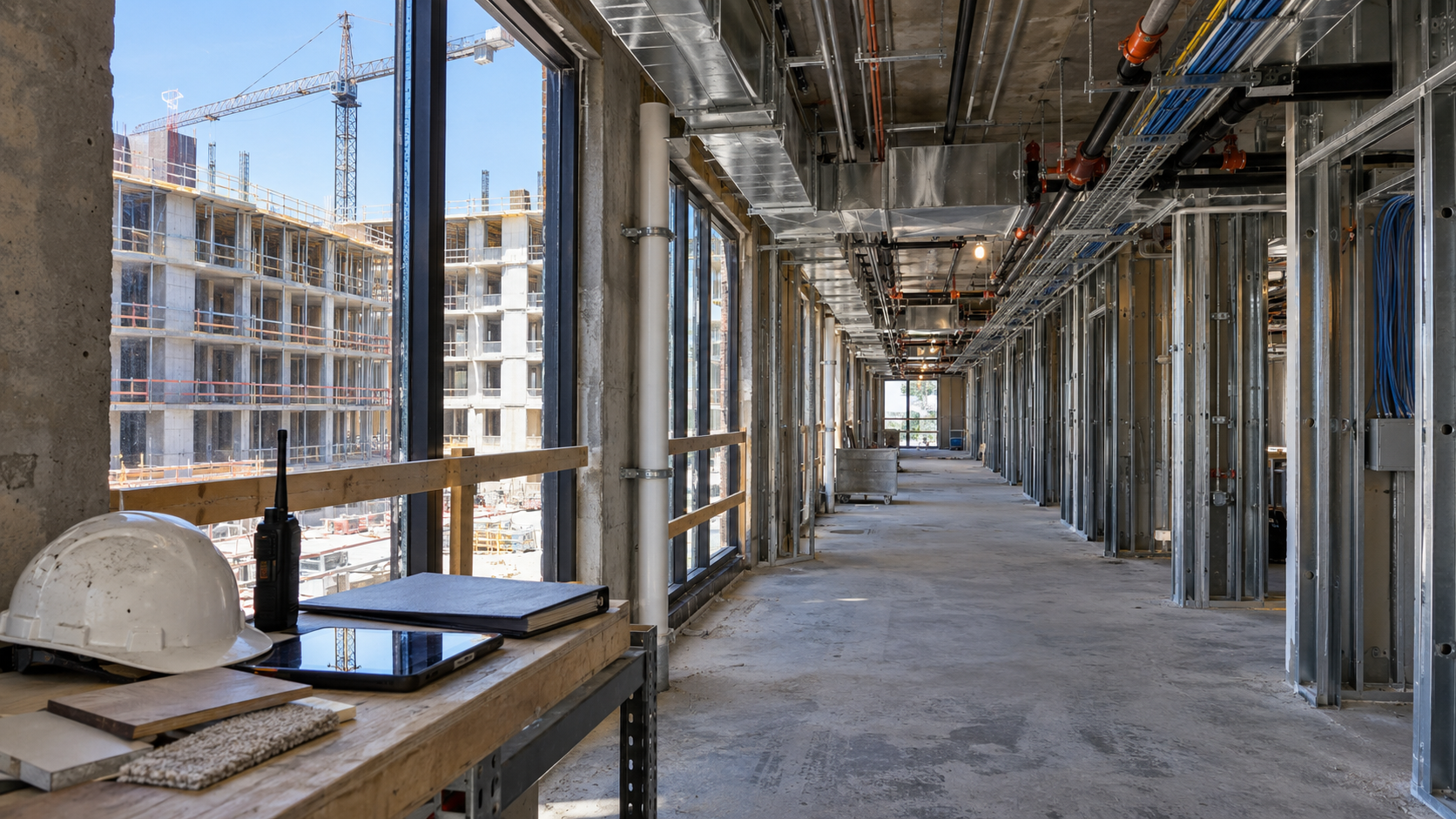
New development gives owners and developers a cleaner opportunity because the network can be designed before the building is finished. That is when decisions about pathways, equipment rooms, power, fiber routes, common-area coverage, unit-level service, and future building technology should be made. Too often, internet is treated as something a carrier will figure out near the end of the project. By then, the pathways may be constrained, equipment locations may be less than ideal, and everyone is trying to solve a permanent infrastructure issue with a late-stage install. That approach usually costs more and produces a weaker result.
Connectivity should be part of the building infrastructure conversation from the beginning. It supports leasing, resident move-in, property operations, common areas, smart access, cameras, and whatever technology gets layered into the building later. For LIHTC developers, broadband can also intersect with QAP scoring, resident amenities, development quality, and long-term livability. The details vary by state, but the broader direction is clear: broadband is no longer something to think about at the end.
When a new development is planned correctly, residents can receive credentials before move-in and connect as soon as they walk into the unit. That creates a better first impression for the resident and removes friction for the leasing team during one of the busiest moments in the resident lifecycle. It also helps adoption ramp as the property stabilizes. The implementation article, How Owners Can Implement Better Internet Without Creating a Mess, covers both paths: retrofits and new development. The work is different, but the goal is the same. Build a network that works for residents, works for the property team, and makes sense for the owner.
What Owners Should Evaluate First
The first step does not need to be complicated. Owners should look across the portfolio and identify where better connectivity could actually move the needle. Which properties have outdated telecom infrastructure? Which assets are still tied to old carrier agreements? Which new developments are early enough in design to make the right infrastructure decisions? Which communities could benefit from better resident experience, QAP scoring, NOI creation, or all three?
From there, the next step is reviewing telecom agreements on a few candidate properties. That usually reveals the real starting point. Sometimes the best candidate is not the property everyone assumed. Sometimes a promising property has contract timing issues. Sometimes the owner has more flexibility than expected. The contracts matter because they dictate available options.
After that, the owner should be looking for a property-specific proposal, not a generic pitch. The proposal should show the deployment plan, resident offer, capex structure, NOI projection, upgrade model, timeline, and what the site team will actually be asked to do. That is what an owner, developer, asset manager, or CFO can evaluate.
Affordable Housing Deserves Better Connectivity
Affordable housing should not get second-class connectivity because the standard market-rate model does not fit. The answer is not to lower expectations. The answer is to design the model around the constraints. That means strong base service, simple activation, flexible upgrades, resident choice where required, a structure that respects affordability, and an operating model that does not bury the site team. It also means giving the owner a way to participate in the value being created at the property and building infrastructure that can support the asset for the next decade or more.
Better internet in affordable housing is not just about speed. Speed matters, but the bigger opportunity is structure. When the model is right, residents get a service they can actually use, the property team gets less friction, and the owner gets a stronger asset. That is the conversation affordable housing owners should be having now.