
For most of multifamily’s history, communications infrastructure occupied a relatively small place in the development process. Electrical, plumbing, structural, mechanical, and life-safety systems were understood to be fundamental to the building and were planned accordingly. Connectivity was different. It was generally treated as a service that could be addressed later, once the larger design decisions had already been made.
A provider would extend service to the property, equipment would be installed close to occupancy, and residents would receive telephone, television, or internet service through infrastructure designed largely to support those functions. At the time, that approach made sense. Relatively few building systems depended on communications infrastructure, and connectivity had little influence on how a property was designed, operated, or expected to perform over decades of ownership.
That has changed. Today, nearly every part of a multifamily community depends on digital infrastructure in some way. Residents rely on connectivity for work, education, healthcare, banking, entertainment, and communication. Property teams depend on cloud-based software, mobile applications, digital leasing platforms, access control, surveillance, package management, energy monitoring, building automation, smart-home technology, and a growing number of connected systems.
The significance of that shift extends well beyond resident internet service. Multifamily connectivity infrastructure has become one of the underlying systems through which a modern apartment community operates.
Multifamily Connectivity Infrastructure Is Supporting More Than Internet
Much like electrical distribution makes power available throughout a property without determining how that power will ultimately be used, communications infrastructure provides the foundation for technologies that will continue to change throughout the life of the building.
Software platforms will change. Network equipment will be replaced. Wireless standards will advance. New building systems will be introduced that may not yet be part of today’s development plans.
The physical infrastructure supporting those technologies is far more permanent.
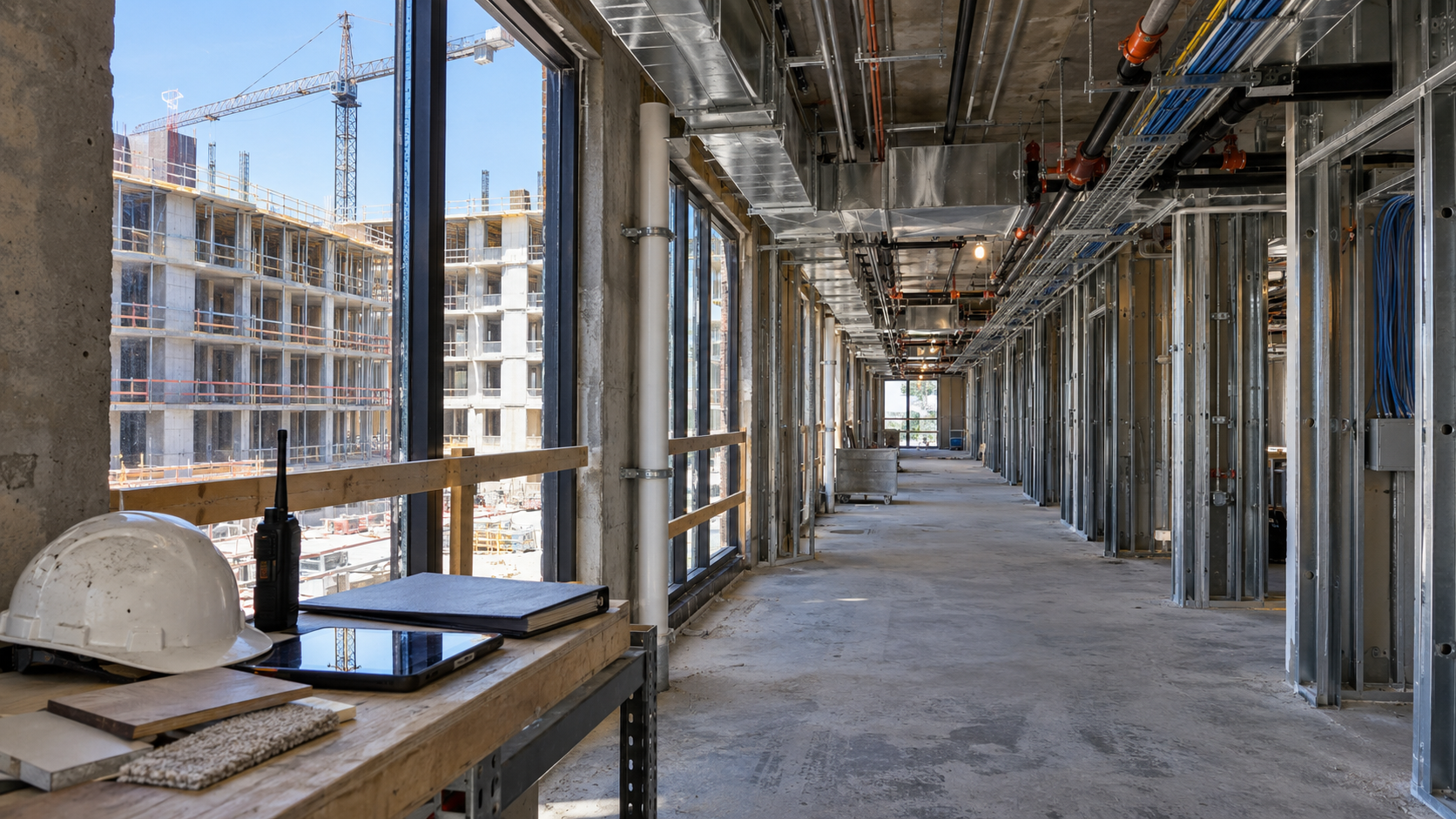
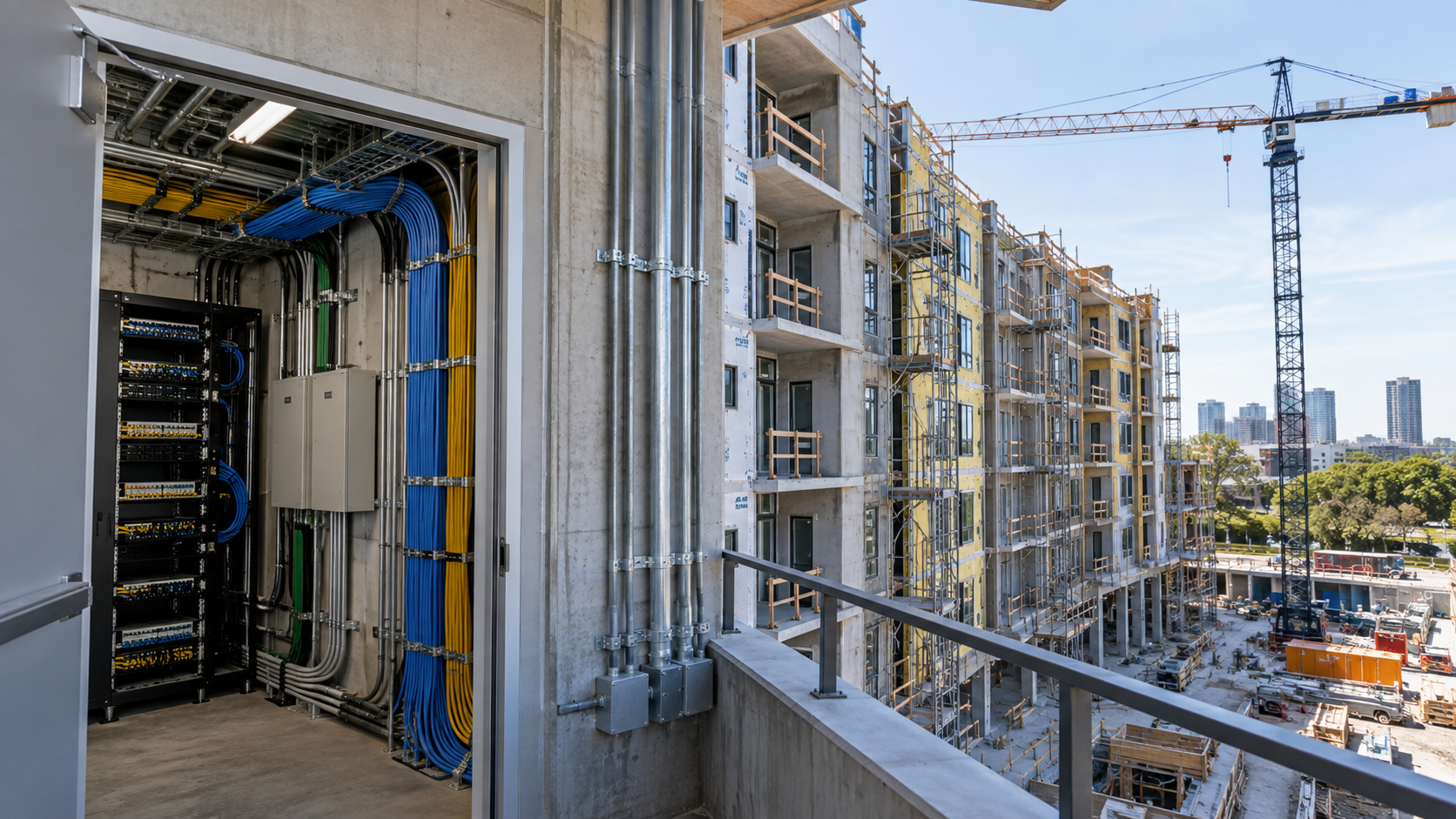
Telecommunications rooms, risers, conduit, fiber routes, utility entrances, pathways, power, and connections between buildings can remain in place through multiple generations of equipment. Decisions made around those elements during development can shape how easily the property adapts years later.
This distinction matters because multifamily connectivity conversations still tend to focus heavily on the technology being installed today. Discussions often begin with internet speeds, service providers, equipment, or resident packages. Those are important decisions, but they represent only one layer of a much larger system.
The more durable question is whether the building itself is prepared to support whatever comes next.
How Connectivity Became Part of Multifamily Operations
The shift did not happen all at once. Connectivity became more important gradually as property operations became more digital and more building systems began relying on the network.
Cloud software replaced locally hosted applications. Maintenance teams moved more of their work onto mobile devices. Access control became connected. Smart-building technology expanded beyond luxury properties and into the broader multifamily market. Resident bandwidth expectations increased as remote work, streaming, gaming, telehealth, and connected devices became part of everyday life.
Individually, each of those changes appeared incremental. Together, they fundamentally changed the role of communications infrastructure within the property.
A network that once existed primarily to deliver internet service to residents now supports a much broader mix of resident experience, property operations, building systems, and technology. That creates a different level of responsibility during development.
Connectivity is no longer simply something a provider brings to the building. Increasingly, it is something the building itself needs to be designed to support.
Early Connectivity Decisions Shape Future Flexibility
The location of a telecommunications room can affect the difficulty of a future network upgrade. The size and accessibility of pathways can determine whether new fiber can be installed without opening walls. Reserve conduit can reduce the cost and disruption of adding capacity later. Accurate documentation can determine whether a future owner understands the infrastructure they inherited.
None of these decisions is particularly dramatic when it is made.
That is partly why they are easy to overlook.
When connectivity enters the development process too late, many of the permanent decisions surrounding it may already be locked in. A pathway may be undersized. A telecom room may be poorly located. A utility entrance may have been designed around the immediate requirements of one provider. Reserve conduit may have been removed during value engineering because there was no obvious use for it at the time.
In most cases, the property will still open successfully. Residents will get connected, operations will begin, and the limitations of the infrastructure may remain invisible for years.
The cost tends to appear later.
Poor Connectivity Planning Often Becomes Future CapEx
The limitations of multifamily internet infrastructure often become apparent when ownership needs the property to do something different.
That may happen when an owner wants to change providers, bring fiber deeper into the property, deploy a new building system, add network capacity, or standardize technology across a portfolio. At that point, infrastructure that appeared adequate during construction can become an expensive retrofit.
Adding infrastructure to a finished and occupied property is a very different undertaking than planning for it during development. Walls may need to be opened. Ceilings may need to be disturbed. Pavement may need to be trenched. New pathways may have to be created through spaces that were never designed to accommodate them.
A decision that saved money during construction can become someone else’s capital project years later.
That is one of the reasons connectivity decisions deserve greater scrutiny during design and value engineering. Removing infrastructure does not necessarily eliminate the need for it. In some cases, it simply pushes the expense into a later phase of the asset’s life, when the work is more complicated and significantly more disruptive.
Connectivity Infrastructure Is an Asset Management Issue
This reality is especially important for owners because communications infrastructure is increasingly becoming an asset-management issue rather than simply a technology issue.
The quality of a property’s connectivity infrastructure can influence operating costs, future CapEx, provider flexibility, resident experience, smart-building deployments, acquisition planning, portfolio standardization, and the ease with which the property can be modernized over time.
When a property changes hands, the new owner inherits far more than the current internet service. They inherit the pathways, telecommunications spaces, cabling, documentation, contracts, access rights, and infrastructure decisions that came with the building.
Well-planned infrastructure gives that owner options. Poorly planned infrastructure creates constraints.
The same principle applies at the portfolio level. Two properties may appear similar on paper and require the same technology upgrade, yet the cost and complexity of deploying it can be dramatically different depending on what was built into each property years earlier.
The technology may be identical. The infrastructure underneath it is not.
For owners evaluating long-term asset performance, that difference matters.
Multifamily Development Has Not Fully Caught Up
Despite the growing importance of connectivity, many multifamily projects still address communications relatively late in the development process, after major architectural, structural, electrical, and civil decisions have already been made.
Responsibility is also frequently divided across architects, engineers, contractors, ownership, technology vendors, utilities, and service providers, each focused on a different portion of the project.
The result is that the first technology installed in the building can end up driving infrastructure decisions that will remain in place long after that technology is obsolete.
For an asset expected to operate for generations, that is a short planning horizon.
Multifamily properties routinely outlast the equipment installed inside them. A network switch, access point, software platform, or service agreement may have a relatively short lifecycle. Telecom rooms, risers, underground conduit, and pathways do not.
Development planning needs to account for that difference.
Plan for Change Instead of Trying to Predict It
The better approach is not to try to predict exactly what technology a property will need ten or twenty years from now. That is nearly impossible, and it is not necessary.
The goal is to create a building that can adapt when those requirements change.
That means approaching multifamily connectivity infrastructure with the same long-term discipline applied to other permanent building systems. Pathways, telecom spaces, reserve capacity, access, documentation, ownership, and coordination all deserve consideration before those decisions become expensive or disruptive to change.
It also means recognizing that connectivity is no longer the responsibility of a single specialist working at the edge of the project.
Developers, architects, engineers, contractors, operators, service providers, and owners all influence the final result. Bringing those stakeholders into the conversation earlier makes it easier to separate short-term technology requirements from the infrastructure the asset will depend on for decades.
The goal is not to design around one provider, one network architecture, or one generation of technology.
It is to preserve the building’s ability to accommodate what comes next.
Connectivity Is Now Part of the Building
Great multifamily properties have always been defined by more than the finishes residents see or the amenities they use. Their long-term performance depends on the systems behind the walls and the decisions made long before anyone moves in.
Communications infrastructure now belongs in that same category.
It should be planned with permanence in mind, coordinated early, documented carefully, and evaluated based on more than the needs of the first technology installed in the building.
That does not mean creating a property that never needs to change. Technology will continue to evolve throughout the life of the asset.
The objective is to create a building that can continue evolving without requiring its permanent infrastructure to be rebuilt every time technology does.