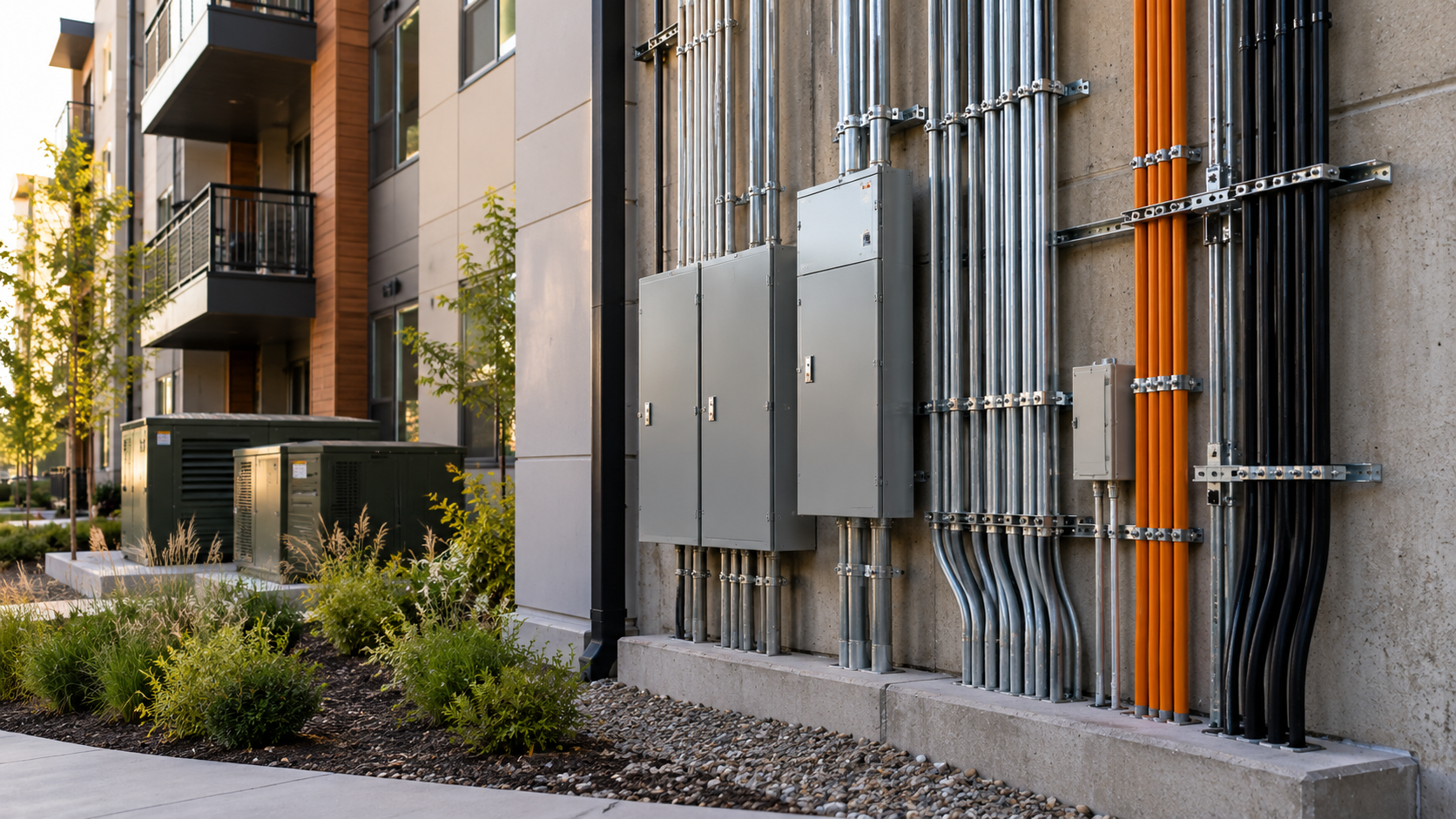

Treating connectivity as part of the building changes more than the way infrastructure is designed. It also changes the way that infrastructure should be managed throughout the life of the asset.
Communications infrastructure does not begin when equipment arrives on site, and its useful life does not end when internet service goes live.
Decisions made during ownership strategy, planning, design, construction, turnover, operations, modernization, and future ownership all influence how well a multifamily property can support changing technology over time.
Looking at connectivity through a lifecycle helps clarify where those decisions belong.
It also makes one important point clear: construction is only one phase in a much longer process.
Choices made early in the multifamily connectivity lifecycle can either preserve flexibility for future owners or create constraints that become increasingly difficult and expensive to correct.
Phase 1: Define the Ownership and Investment Strategy
The connectivity lifecycle begins before drawings are produced or equipment is selected.
Ownership first needs to establish how connectivity fits within the broader investment and operating strategy of the property.
That includes considerations such as:
- Expected hold period
- Resident experience goals
- Property operations requirements
- Building technology needs
- Infrastructure ownership preferences
- Provider flexibility
- Long-term capital planning
- Priorities for future expansion
The objective at this stage is not to choose specific technologies.
It is to give the development team enough direction to understand what the building will be expected to support and which long-term considerations should influence the decisions that follow.
A property intended for long-term ownership, for example, may place greater value on reserve capacity, infrastructure control, documentation, and the ability to change providers or technologies without major reconstruction.
Those priorities should be established before permanent building decisions begin.
Key outcome: A documented multifamily connectivity strategy that defines ownership objectives and gives the design team a clear framework for the decisions that follow.
Phase 2: Translate the Connectivity Strategy Into the Building
Planning and design are where connectivity moves from an operating concept into the physical building.
Telecommunications rooms are located. Utility entrances and backbone pathways are coordinated. Electrical and environmental requirements are incorporated. Future expansion is considered alongside the needs of the initial installation.
This is also the phase where communications infrastructure begins interacting with nearly every other major building discipline.
Architecture, civil, structural, electrical, mechanical, low-voltage, and technology teams can all influence the finished system.
That means multifamily connectivity infrastructure cannot be designed effectively in isolation.
The most important distinction at this stage is between technology that may change quickly and infrastructure that is likely to remain in place for decades.
Network equipment, providers, wireless standards, and software will evolve.
Telecommunications spaces, pathways, conduit, backbone routes, utility entrances, and other permanent elements of the building are much harder to modify once construction is complete.
Design decisions should account for that difference.
The goal is not to predict every technology the property may eventually use. It is to create a physical framework that can support change without requiring ownership to repeatedly modify permanent portions of the building.
Key outcome: Coordinated construction documents that support current connectivity requirements without limiting the building’s ability to adapt later.
Phase 3: Protect the Design Through Construction
Construction turns design intent into the physical infrastructure ownership will eventually inherit.
Quality during this phase depends on workmanship, but it also depends on how well field changes are coordinated when actual conditions differ from the drawings.
Changes to pathways, telecommunications rooms, equipment locations, conduit, or supporting building systems should not be treated as isolated installation decisions.
A field modification that solves an immediate construction problem can create a long-term constraint if it reduces future capacity, limits access, or is never reflected in the project documentation.
This is one of the points in the connectivity lifecycle where seemingly small decisions can have an outsized impact.
A conduit removed during value engineering, a telecommunications room reduced in size, or a pathway rerouted around another building system may not prevent the property from opening.
Each, however, can affect future upgrades, maintenance, provider changes, or modernization.
Changes made in the field should therefore be evaluated against the original infrastructure strategy, not simply against the immediate needs of construction.
They should also be documented as the project progresses so the final as-built records reflect what ownership actually receives.
Key outcome: Installed communications infrastructure that reflects the project’s long-term intent, with field changes reviewed, coordinated, and documented during construction.
Phase 4: Verify the Infrastructure and Transfer Responsibility
Before ownership accepts the completed system, multifamily connectivity infrastructure should be evaluated for more than opening-day functionality.
Testing can confirm performance, but connectivity turnover should also establish that the infrastructure is complete, documented, accessible, and ready for long-term operation.
A complete turnover process may include:
- Accurate telecommunications as-built drawings
- Fiber and cable testing records
- Equipment inventories
- Labeling standards
- Pathway and backbone documentation
- Warranty information
- Operating documentation
- Access procedures
- Defined owner and provider responsibilities
Planned reserve capacity should also be documented while the original project team is still available to verify it.
That may include spare fiber, available conduit, equipment space, backbone capacity, and other provisions intended to support future expansion.
The goal is for the building to stand on its own after construction ends.
Ownership should not have to rely on a former installer, contractor, or project manager to understand where infrastructure is located, what capacity remains available, or who is responsible for maintaining a particular component.
Key outcome: A verified infrastructure system and complete connectivity turnover package that ownership can manage independently.
Phase 5: Maintain Connectivity Infrastructure During Operations
Operations represent the longest phase of the multifamily connectivity lifecycle.
Once the property is occupied, the network supports more than resident internet service.
It may also support property operations, access control, security systems, IoT devices, building automation, leasing functions, maintenance tools, and an expanding number of connected systems.
That makes ongoing infrastructure governance just as important as the quality of the original installation.
Documentation should be updated as equipment, pathways, and network systems change.
Labeling and organizational standards should remain consistent.
New installations should be evaluated against the same principles used during development rather than added wherever space happens to be available.
Without that discipline, even a well-designed property can gradually accumulate complexity.
Telecommunications rooms become crowded. Labeling becomes inconsistent. Pathways become difficult to trace. Documentation no longer reflects actual conditions.
Each change makes the next project more difficult.
The objective during operations is to preserve the quality of the underlying infrastructure so each improvement builds on an organized foundation instead of creating additional complexity for the future.
Key outcome: Current documentation, consistent operating standards, and communications infrastructure that remains understandable as the property evolves.
Phase 6: Modernize Without Rebuilding the Property
No communications technology remains current for the entire life of a multifamily asset.
Network electronics will be replaced. Wireless standards will advance. Resident bandwidth requirements will increase. Building technologies will continue to evolve.
The measure of strong connectivity infrastructure is not whether the technology installed at opening remains relevant forever.
It is whether new technology can be introduced without requiring ownership to repeatedly reconstruct the permanent parts of the property.
Accessible pathways, available capacity, organized telecommunications spaces, adequate power, and reliable documentation all reduce the cost and disruption associated with modernization.
The better those elements were planned and maintained in earlier phases, the easier it becomes to:
- Change internet providers
- Add network capacity
- Upgrade Wi-Fi
- Replace network electronics
- Deploy new building systems
- Add fiber
- Expand operational technology
- Standardize infrastructure across a portfolio
This is where the value of earlier lifecycle decisions becomes especially visible.
Infrastructure that preserved flexibility during design and remained organized during operations gives ownership more options when technology eventually changes.
Key outcome: Updated technology that uses the property’s existing physical framework efficiently rather than forcing the building to be reconstructed around it.
Phase 7: Transfer Infrastructure Knowledge to the Next Owner
Most multifamily properties will move through multiple ownership cycles.
That makes acquisition and disposition another important phase of the connectivity infrastructure lifecycle.
A buyer inherits far more than the property’s current internet service.
They also inherit telecommunications rooms, pathways, cabling, fiber, equipment, documentation, provider agreements, access rights, infrastructure ownership boundaries, and the cumulative results of every connectivity decision made before the transaction.
Good infrastructure governance reduces uncertainty during due diligence.
Current drawings, equipment records, testing information, ownership boundaries, provider agreements, and documented capacity give prospective owners a clearer understanding of what they are acquiring and what future investment may be required.
Connectivity can therefore become part of understanding the condition and flexibility of the larger asset.
This is also where the lifecycle begins again.
A new owner may establish different operating priorities, change providers, introduce new technology, or modernize the property according to a different investment strategy.
The quality of the communications infrastructure they inherit will shape how easily those changes can be made.
Key outcome: Transferable infrastructure knowledge that supports due diligence, operational continuity, and the next ownership strategy.
The Multifamily Connectivity Lifecycle at a Glance
| Lifecycle Phase | Primary Objective | Key Outcome |
| Ownership and Investment Strategy | Define what connectivity needs to accomplish for the asset | Ownership goals and connectivity strategy |
| Planning and Design | Integrate connectivity into the physical building | Coordinated construction documents |
| Construction and Coordination | Build while preserving long-term design intent | Installed and documented infrastructure |
| Verification and Turnover | Confirm readiness and transfer responsibility | Complete turnover package |
| Operations and Continuous Improvement | Preserve infrastructure quality over time | Current documentation and consistent governance |
| Modernization and Renewal | Introduce new technology with limited disruption | Upgraded systems using the existing physical framework |
| Acquisition and Future Ownership | Transfer infrastructure knowledge and flexibility | Due diligence records and institutional continuity |
Connectivity Is a Lifecycle, Not a Project
Construction occupies only a small portion of the life of a multifamily property.
The decisions made during that period will influence years of operations, technology upgrades, capital planning, provider changes, renovations, and future ownership transitions.
That is why communications infrastructure should not be judged only by whether the property opens on time or whether the network works on day one.
A stronger measure is whether the building remains easy to understand, maintain, modify, and modernize as requirements change.
Each phase of the multifamily connectivity lifecycle should leave the property better prepared for the one that follows.
Strategy should give design direction.
Design should create a flexible physical framework.
Construction should preserve and document that intent.
Turnover should give ownership the information needed to operate independently.
Operations should maintain the quality of the infrastructure.
Modernization should take advantage of the flexibility created earlier.
Future ownership should inherit enough information to make informed decisions without reconstructing the property’s connectivity history.
When that happens, connectivity becomes more than a construction scope or utility service.
It becomes infrastructure that continues supporting the asset long after the original technology has been replaced.