
A plain-language guide to bulk internet, retail resident-choice, and managed Wi-Fi, for multifamily owners who want the real story.
Most owners didn’t sign up to become internet experts. You signed up to run a well-performing asset.
But at some point, someone handed you a contract with a cable company, your residents started complaining about slow speeds, and your leasing team started fielding tech support calls. And somewhere in there, the internet became your problem.
The frustrating part: it doesn’t have to be. But making a smarter decision starts with understanding what you’re actually choosing between.
The Three Models. Plainly.
When it comes to internet in a multifamily property, you’re evaluating one of three setups. Here’s what they actually mean.
Retail (Resident Choice)
Each resident calls Comcast or AT&T, sets up their own account, and manages their own service. The property provides the building infrastructure; each household handles everything else.
From your perspective, it feels hands-off. And it is, until it isn’t. When a resident’s connection drops during a Zoom call, the complaint doesn’t go to the ISP. It goes to your leasing office.
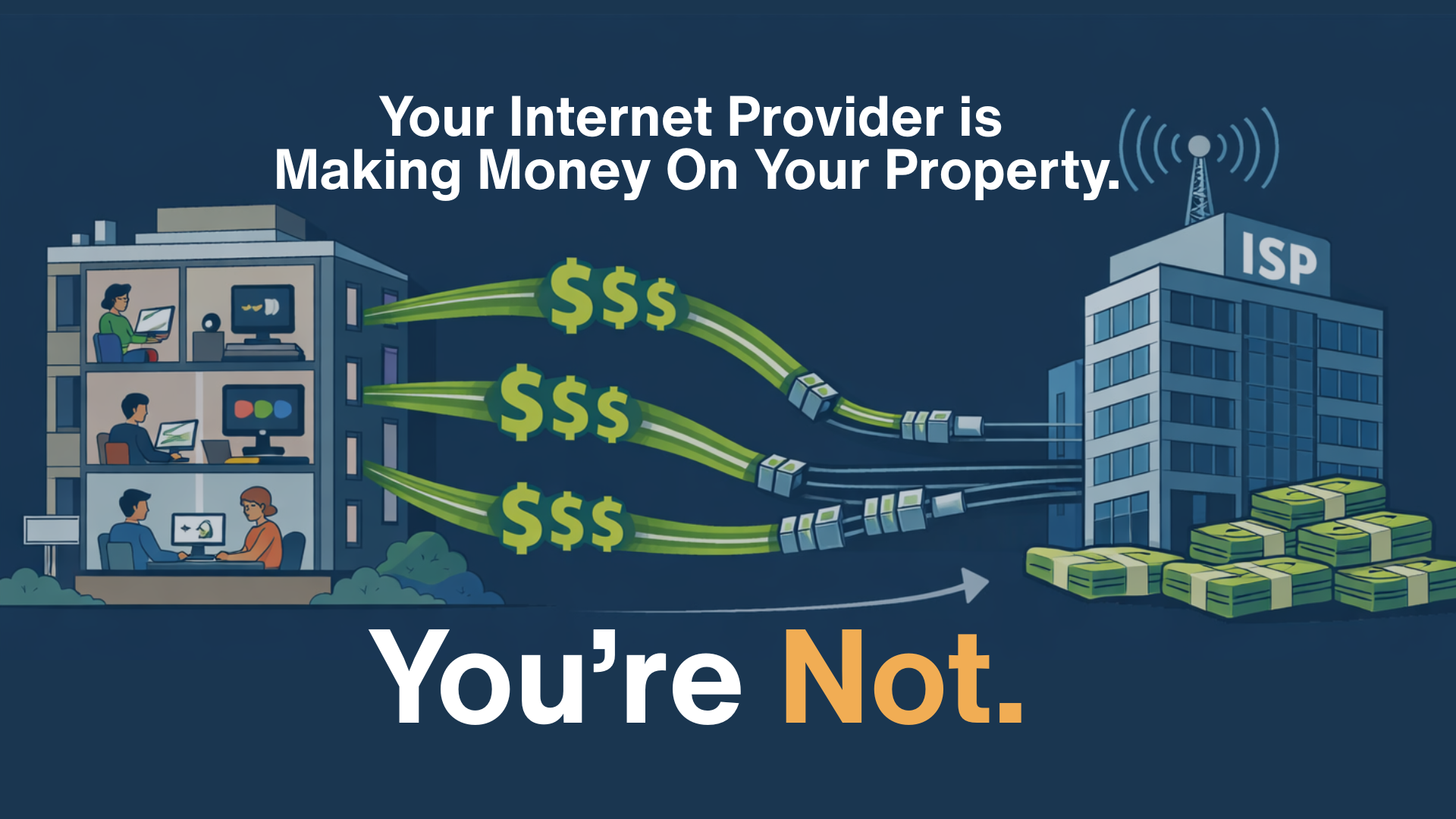
Retail models are built around the ISP’s priorities. Not yours. Not your residents’. Pricing, control, and accountability all sit with the provider. Your property adapts around it.
Bulk Internet
The property signs a single agreement. You negotiate a per-unit rate that covers all residents, then recover the cost through rent or a technology package. One contract. One provider.
Done right, bulk internet simplifies move-ins, gives you more say in the resident experience, and can create a meaningful revenue line. Done wrong, it becomes a different kind of headache, one-size-fits-all service that residents resent and a contract that ties your hands for years.
The structure matters. So does the provider you choose.
Managed Wi-Fi
A professionally designed, property-wide network. Access points are placed throughout the building, service is monitored around the clock, and support is handled by the provider — not your onsite team.
It sounds like the best of both worlds. And it can be. But managed Wi-Fi has a real ceiling. Many systems are locked at 1 Gbps and built on equipment that can’t scale as resident demand grows. What looks like infrastructure today can feel outdated in five years.
The question isn’t just “is this managed?” It’s: “Is this built to last?”
What’s Actually at Stake
Internet that isn’t working isn’t just an amenity problem. It’s a retention problem.
Residents who work from home aren’t asking if Wi-Fi is available. They’re assuming it works. When it doesn’t, they remember, and they don’t renew.
Common areas without reliable coverage. Units with dead zones. Buildings where the connection works fine in some spots and drops in others. These aren’t just inconveniences. They’re reasons people leave.
At the same time, properties that get connectivity right are seeing something different: faster lease-ups, stronger retention, fewer complaints hitting the leasing desk, and in many cases, a real, measurable line of income that didn’t exist before.
Internet is no longer a utility that runs in the background. It’s infrastructure. And like any infrastructure decision, it has long-term consequences.
The Decisions That Actually Matter
Before you start collecting proposals, it helps to get clear on what you’re optimizing for. A few questions worth sitting with:
Who owns the support experience?
This is the one most owners underestimate. When a resident’s internet goes down at 11 PM, who fields it? If the answer is “your property manager,” that’s a problem. The right provider absorbs complexity. They don’t export it.
What does the infrastructure actually support?
Access control. Security cameras. Smart thermostats. Package rooms. Leasing software. All of it runs on the network. A fragmented setup, residents on different providers, equipment scattered across units, makes everything harder and more expensive.
How long are you holding?
A short-term hold has different calculus than a 10-year strategy. If you’re planning to sell, connectivity that’s visible in your financials matters. If you’re holding, you want a network built to scale. Know your timeline before you sign anything.
What’s the contract actually saying?
Exclusivity clauses. Revenue-sharing arrangements. Disclosure requirements. These have real regulatory implications in multi-tenant environments. Read them carefully. The FCC has taken steps to improve competition in apartment buildings, understand your obligations and your options before you commit.
How to Compare Providers Without Getting Lost
Once you’re ready to evaluate, these are the questions that separate vendors who are built for multifamily from ones who are adapted for it.
- What does your SLA cover, and what doesn’t it cover? Ask about outage response, resolution times, and escalation paths. Vague answers are a signal.
- Is support actually 24/7? And who answers — the provider, a third party, or the onsite team?
- How do you handle resident onboarding at move-in? Is it automated, or is there a setup process that creates friction?
- How is the network designed for density? In a building with hundreds of units, interference management matters. Ask how they solve for it.
- Do residents get their own network credentials and traffic segmentation? Neighbors shouldn’t be able to see each other’s devices.
- What reporting do you provide? Uptime, utilization, top issues. Owners shouldn’t have to wait for complaints to know something is wrong.
- What happens when a resident upgrades or moves out? Is turnover handled automatically, or does it create work for your team?
Score each provider honestly across resident experience, operational simplicity, financial impact, security, and long-term flexibility. Weight them based on your asset strategy. A lease-up property may prioritize experience above all else. A stabilized workforce community may weight operational efficiency higher.
The Short Version
Retail is the path of least resistance for owners in the short term — and the path of most friction for residents. You hand off the cost, but you also hand off control.
Bulk can deliver better economics and a smoother move-in experience, but only when the rollout is intentional and the provider is accountable.
Managed Wi-Fi delivers consistency — when it’s properly designed, when the SLAs are real, and when the infrastructure is built to grow. When it isn’t, it becomes a ticking clock on your NOI.
The right answer is the one that fits your resident profile, your operating model, and your long-term plan for the asset. It isn’t the same for every property.
If a network isn’t built around the property, it was built around someone else’s priorities.
Talk to Us
Internet Subway works with multifamily owners who want connectivity that’s designed around how properties actually operate, not bolted on as an afterthought.
If you’re evaluating your options or questioning what you currently have, reach out. We’ll give you a straight answer.